

Carbon Fiber Stick Performance: 2026 Guide
Table of Contents
- What Actually Drives Carbon Fiber Stick Performance?
- Hockey Stick Carbon Fiber Weave Explained
- Quick Comparison: Standard vs. Aerospace-Grade Carbon Fiber
- The Benefits of Aerospace Grade Carbon Fiber
- Impact of Kick Point Technology on Shot Speed
- Durability and Longevity: Does High-Performance Mean Fragile?
- Choosing Carbon Fiber Sticks for Your Playing Style
- Final Thoughts on Carbon Fiber Stick Performance
- Frequently Asked Questions
Last Updated: September 7, 2026
What Actually Drives Carbon Fiber Stick Performance?
Ask ten players why they chose their stick and most will cite weight or flex. The real answer sits deeper. The performance difference in carbon fiber sticks comes down to three variables: the grade of carbon fiber, the layup configuration, and how those materials transfer energy through the shaft during a shot.
Carbon fiber sticks are composite structures built from thousands of microscopic filaments bound in a polymer matrix. When you shoot, the shaft bends and stores elastic energy, then releases it as the blade whips through the release zone. A stick that stores more energy and returns it efficiently produces a faster shot with less effort.
The gap between a budget stick and a premium one is not marketing hype; it is measurable in release speed, accuracy, and consistency over a season. This guide breaks down the engineering so you can choose with confidence.
The most important concept is stiffness-to-weight ratio. A stiffer material can be made thinner and lighter while resisting bending, meaning more of your energy transfers into the puck rather than flexing the shaft uselessly. That same property separates elite hockey sticks from entry-level models.
Hockey Stick Carbon Fiber Weave Explained
Carbon fiber does not come in one flavor. The weave and fiber orientation determine how a stick behaves under load, and manufacturers choose specific configurations to tune flex, durability, and feel.
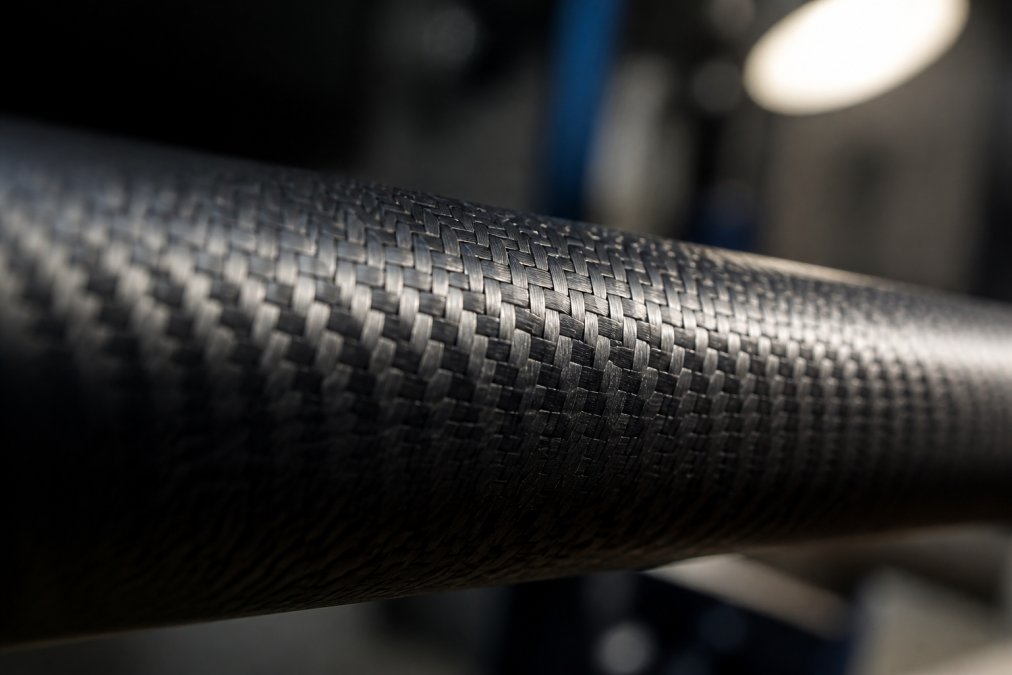
The most common designations are 3K, 12K, and 18K, referring to the number of filaments per tow, the bundle of fibers woven together. A 3K weave uses smaller tows, creating a tighter, more detailed fabric that is easier to mold into complex shapes. Higher tow counts use thicker bundles, which lay up faster and can add impact resistance, though often with a slightly higher weight penalty.
Beyond weave density, engineers layer unidirectional (UD) fiber alongside woven fabric. UD fiber has all filaments running parallel, offering maximum axial strength along the shaft length. Woven layers add torsional stiffness, resisting twisting when you receive a pass or battle along the boards. The combination of these layers, called the layup configuration, is the hidden recipe that defines how a stick loads and releases.
This matters because it directly affects your shot. A stick built primarily for axial strength will feel stiff and explosive on slap shots. One with more woven layers for torsion will feel stable on snap shots and backhands but may sacrifice some raw velocity.
Quick Comparison: Standard vs. Aerospace-Grade Carbon Fiber
Not all carbon fiber performs equally. Aerospace-grade material undergoes stricter manufacturing tolerance and quality control than commodity carbon, resulting in fewer voids and defects in the resin matrix. Those imperfections are where sticks fail and where energy leaks out during a shot.
Property |
Standard Carbon Fiber |
Aerospace-Grade Carbon Fiber |
|---|---|---|
Fiber consistency |
Variable tow alignment |
Tightly controlled |
Resin quality |
Standard polymer matrix |
High-performance matrix |
Weight |
Heavier per unit stiffness |
Lighter at equal stiffness |
Energy return |
Moderate |
Higher return force |
Price point |
Entry to mid-level |
Premium |
The practical result is a stick that feels livelier. When you lean into a shot, the shaft loads predictably and springs back with more stored energy directed into the puck. This is the performance difference in carbon fiber sticks that players notice immediately.
Tensile Modulus and Stiffness-to-Weight Ratio
Tensile modulus measures how much a material resists stretching under load. Higher modulus carbon fiber is stiffer, meaning it deforms less for a given force. For a hockey stick, that translates to thinner walls while maintaining structural integrity, reducing weight without sacrificing strength.
A lighter stick with high tensile modulus lets you generate greater stick speed on wrist shots and maintain energy through a full third period. The trade-off historically has been durability, as ultra-high-modulus fibers can be more brittle, but modern manufacturing has largely solved this with strategic reinforcement layers.
The Benefits of Aerospace Grade Carbon Fiber
The benefits of aerospace grade carbon fiber show up in three measurable areas: weight distribution, energy transfer, and consistency. A stick built from this material can place more mass where it matters, like the blade and lower shaft, while keeping overall weight low.
Energy transfer is where aerospace material earns its keep. When the shaft bends during a shot, it stores kinetic energy. As it returns to shape, that energy transfers to the blade and then the puck. A higher-grade carbon fiber with a cleaner resin matrix returns energy more completely, meaning less of your effort dissipates as heat and vibration.
Consistency matters just as much as raw performance. Manufacturing tolerance in aerospace-grade production means each stick performs identically to the next. When you order a backup stick, you want it to feel exactly like your game stick. Lower-grade carbon can vary between production runs, leaving you with a stick that feels slightly different every time you replace it.
Impact of Kick Point Technology on Shot Speed
The kick point is the location along the shaft where it bends most during a shot, and it fundamentally shapes how a stick loads energy. The impact of kick point technology on shot speed is direct: a low kick point loads quickly near the blade for fast wrist shots, while a high kick point stores more energy higher up the shaft for powerful slap shots.
The kick point is not just a geometric feature; it is a function of where the layup is stiffest and where it is allowed to flex. Manufacturers create a low kick point by using a more compliant (softer) weave pattern in the lower third of the shaft, often with unidirectional fiber oriented to bend easily in that zone. Above that zone, the layup becomes progressively stiffer. When you load the stick, the shaft flexes preferentially at the soft zone, storing energy there like a compressed spring.
With a low kick point, the flex zone sits close to the blade, so the shaft returns to shape quickly as your top hand pushes forward. The energy releases in a short, explosive window, ideal for snap shots where you have minimal time to load. With a high kick point, the flex zone sits closer to your bottom hand, creating a longer lever arm. The shaft bends over a greater length, storing more total energy, but releasing it over a slightly longer duration. That longer release window translates to more raw velocity on slap shots where you have time for a full wind-up.
A shaft with a clean, void-free resin matrix and tightly controlled fiber orientation returns energy with minimal loss to internal friction and heat. Lower-grade carbon with more micro-voids in the resin absorbs some of that energy as the fibers rub against imperfections during flex, dulling the release. This is why two sticks with identical flex ratings can feel dramatically different on the shot.
Quick-release shooters who rely on snap shots and one-timers favor a low kick point that loads instantly. Players who generate power through big wind-ups and slap shots typically prefer a mid-to-high kick point that stores more energy over a longer loading zone.
Modern sticks increasingly use hybrid profiles that blend characteristics. A hybrid kick point adapts to your shooting motion, providing a quick load for snap shots while still offering power on slap shots.
At Epix Hockey, we engineer proprietary kick point technologies including Neo-Mid, LightSpeed Low, and Synth Hybrid to match different release styles. Our testing shows that matching kick point to shooting style produces measurable gains in both release speed and accuracy, which is why we offer customizable stick specifications rather than a one-size-fits-all flex curve.
Durability and Longevity: Does High-Performance Mean Fragile?
A common fear is that a lighter, high-performance stick will snap more easily. The relationship between weight and durability is more nuanced. Aerospace-grade carbon fiber with a quality resin matrix is actually highly impact-resistant, capable of absorbing the abuse of blocked shots and board battles.
Durability comes down to how the layers are engineered. A stick that uses high-modulus fiber throughout may be stiff and light, but it can be prone to material fatigue over time. Better designs use a blend, placing reinforcement layers at stress points like the hosel and lower shaft where breakage most often occurs.
Sticks fail progressively, not suddenly. Micro-cracks form in the resin matrix after repeated impacts, eventually propagating until the shaft gives way. A well-constructed stick resists this crack growth longer, maintaining its flex profile and performance over more games.
A 3K weave, with its tighter, more interlocked structure, tends to resist crack propagation better because a developing crack must navigate around more fiber intersections. Higher tow counts use thicker bundles that lay up faster, but the larger resin-rich zones between tows can act as pathways for cracks to travel once initiated. Unidirectional fiber layers, while excellent for axial stiffness, are the most vulnerable to longitudinal splitting. This is why quality manufacturers alternate UD and woven layers: the woven layers act as crack arrestors, stopping a split from running the full length of the shaft.
You can monitor this degradation. Tap the shaft along its length with a knuckle; a healthy stick produces a consistent, ringing tone. A dull or thudding response in one zone indicates delamination, where layers have separated internally. Run your fingers along the shaft edges, feeling for any roughness or splintering. Surface spider-webbing, fine hairline cracks in the clear coat, is cosmetic, but cracks that penetrate into the carbon itself are structural. Flex the shaft gently by hand; if you feel or hear a creak, the resin matrix is compromised.
Store sticks at room temperature rather than in a cold garage, as extreme cold can make the resin matrix more brittle. Avoid leaving sticks in a hot car trunk in summer, as heat can soften the resin and allow the fibers to shift, permanently altering the flex profile. Inspect the shaft regularly for surface cracks or soft spots, and retire a stick at the first sign of structural damage before it fails mid-game.
Minor cosmetic damage, such as a scuffed clear coat or a small chip in the paint, does not affect performance. You can protect these areas with clear tape or a light application of epoxy to prevent moisture from seeping into the carbon layers. Moisture intrusion is a silent killer: water that penetrates the resin matrix can freeze and expand in winter, forcing layers apart and accelerating failure.
Choosing Carbon Fiber Sticks for Your Playing Style
Your ideal stick depends on how you play, not just what looks best in the rack. The performance difference in carbon fiber sticks only helps if the specifications match your game.
For quick, deceptive shooters who score in tight, a low kick point with a lighter overall weight suits your release. You generate shot velocity through stick speed rather than raw power.
Power shooters who wind up from the point or blast one-timers should prioritize a mid-to-high kick point with a stiffer flex. You need a shaft that stores maximum energy during a longer loading zone, trading some quickness for raw shot velocity.
For players who do a bit of everything, a hybrid profile offers the best of both worlds. You get a quick enough load for wrist shots in alone while retaining power for slap shots from the circle.
A junior or intermediate player's game evolves quickly. Choosing a flex and kick point that suits their current style while allowing room to grow ensures the stick remains useful as their shot develops. Epix Hockey offers DARKMATTER sticks in Senior, Intermediate, and Junior sizes so players at every level can access aerospace-grade construction.

Final Thoughts on Carbon Fiber Stick Performance
The performance difference in carbon fiber sticks comes down to material quality, layup engineering, and matching specifications to your game. Aerospace-grade carbon fiber delivers measurable gains in weight, energy return, and consistency, but only when paired with the right kick point and flex for your shooting style.
Whether you are upgrading from a recreational stick or fine-tuning your game stick, the principles in this guide apply across every brand and price point.
Epix Hockey builds sticks using aerospace-grade carbon fiber and our Elite Fusion Matrix material, with proprietary kick point technologies like Neo-Mid, LightSpeed Low, and Synth Hybrid. Our third-party validated testing shows an average 3.2% increase in release speed and 4.3% improvement in accuracy when players use specifications matched to their style. Every stick is customizable to your exact flex, curve, and shaft characteristics.
Frequently Asked Questions
Does the carbon fiber weave pattern (3K vs 12K) affect stick durability?
Yes, but not in the way most players assume. A 3K weave is denser and allows for more precise resin distribution, which can improve impact resistance along the shaft. A 12K weave uses thicker tows that can increase overall strength in specific layup configurations. The durability of a carbon fiber stick depends more on the resin matrix and the quality of the manufacturing process than the weave density alone. A well-constructed 3K stick will outperform a poorly made 12K stick in longevity tests.
What is the actual performance impact of higher-grade carbon fiber in hockey sticks?
Higher-grade carbon fiber, often called aerospace-grade, provides a superior stiffness-to-weight ratio. This translates to a lighter stick that stores and returns more energy on release. In practice, this means a faster shot velocity and a more consistent flex profile, shot after shot. Lower-grade materials can feel 'dead' or inconsistent, particularly in cold conditions. The difference is most noticeable on quick releases where the stick must load and unload energy rapidly.
How does carbon fiber provide a faster release speed than traditional materials?
Carbon fiber has a much higher tensile modulus and lower material fatigue compared to fiberglass or wood. When you load a carbon fiber stick during a shot, it stores a high amount of elastic energy. That energy is then transferred directly to the puck, rather than being absorbed by the material itself. The low weight of carbon fiber also allows for a quicker stick swing, adding to the release speed. This energy transfer is why carbon fiber sticks have dominated elite levels of hockey.
Why does kick point technology matter for my shot?
The kick point dictates where the stick bends the most during a shot. A low kick point, like the LightSpeed Low, loads quickly near the blade for a fast release, suited for snipers. A mid or hybrid kick point, such as the Synth Hybrid, offers a balance of power and control, storing more energy for harder shots from distance. Choosing the right kick point for your shooting style ensures you are transferring the maximum amount of energy from your muscles into the stick, rather than fighting its natural flex profile.