

How to Improve Slap Shot Power: Complete Technique Guide
Table of Contents
- Understanding Slap Shot Mechanics and the Kinetic Chain
- Stance, Positioning, and Hand Placement on the Shaft
- The Wind-Up, Backswing, and Weight Transfer
- Best Stick Flex for Slap Shots and Equipment Optimization
- Point of Contact, Follow-Through, and Release Technique
- Hockey Shooting Drills for Power and Accuracy
- Common Slap Shot Mistakes That Reduce Power
- Putting It All Together: Your Slap Shot Power Development Plan
- Frequently Asked Questions
Last Updated: September 2, 2026
Understanding Slap Shot Mechanics and the Kinetic Chain
The slap shot's explosive power comes from the kinetic chain, energy flowing sequentially from your core through your hips, shoulders, and finally into the blade. Each segment builds on the previous one; if any link breaks, you lose velocity. Most players focus only on arm strength, which is why they plateau. The real power comes from the ground up.
Think of your body as a whip. The handle (your core and hips) moves first and slowest. Each segment accelerates faster than the one before it, until the tip (your stick blade) moves fastest. When you load your stick during the backswing, you store elastic energy in the shaft. On the downswing, you release that energy explosively. The timing and coordination of these movements determine whether you generate a weak tap or a devastating shot.
Stance, Positioning, and Hand Placement on the Shaft
Position your feet shoulder-width apart, with your shooting-side foot slightly back. This allows you to load your weight onto your back leg during the wind-up and transfer it forward through the shot. Your knees should be slightly bent, creating an athletic posture that lets you rotate freely.
Hand placement directly affects your control and power. Your top hand should be near the middle of the shaft, giving you leverage and control. Your bottom hand belongs near the end of the stick, providing the power source. Most players grip too high on the shaft, which reduces their ability to load the stick effectively.
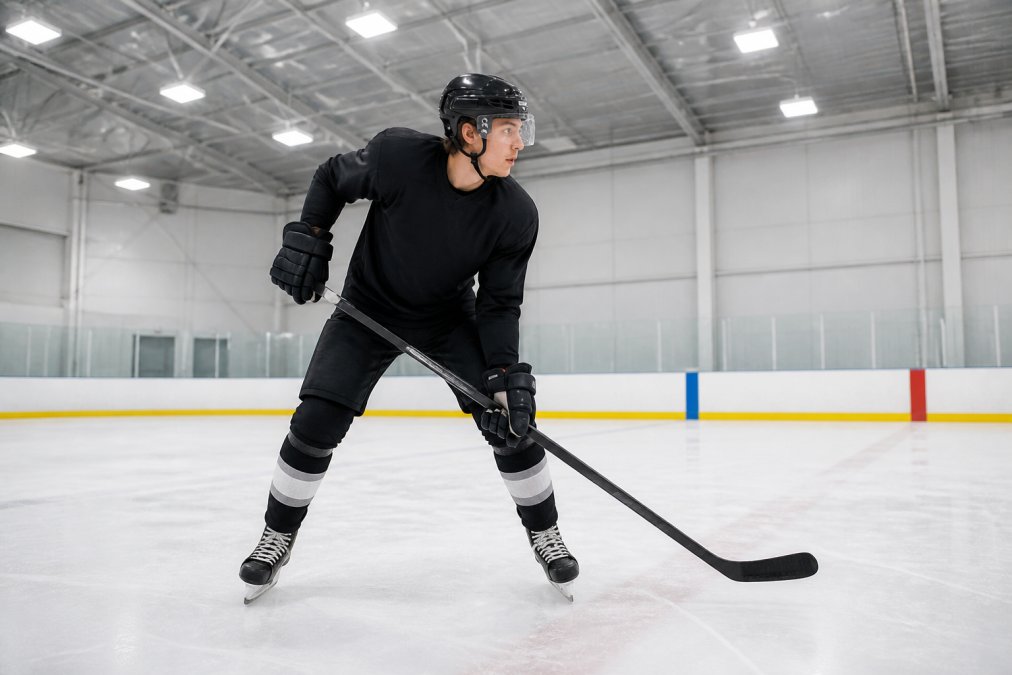
Your blade should make full contact with the ice at the point of impact. Keep your blade flat on the ice through the contact point rather than trying to lift the puck immediately. Your weight should shift explosively from your back foot to your front foot during the shot. Position the puck roughly one stick-length away from your body, giving you room to load the stick without cramping your motion.
The Wind-Up, Backswing, and Weight Transfer
Raise your stick to shoulder height on your backswing, keeping your arms relatively straight and your wrists firm. As you bring the stick back, your weight shifts onto your back foot and your hips begin to rotate. This is where the kinetic chain truly starts: your lower body initiates the motion, your hips rotate first, your shoulders follow, then your arms. This sequential activation generates velocity.
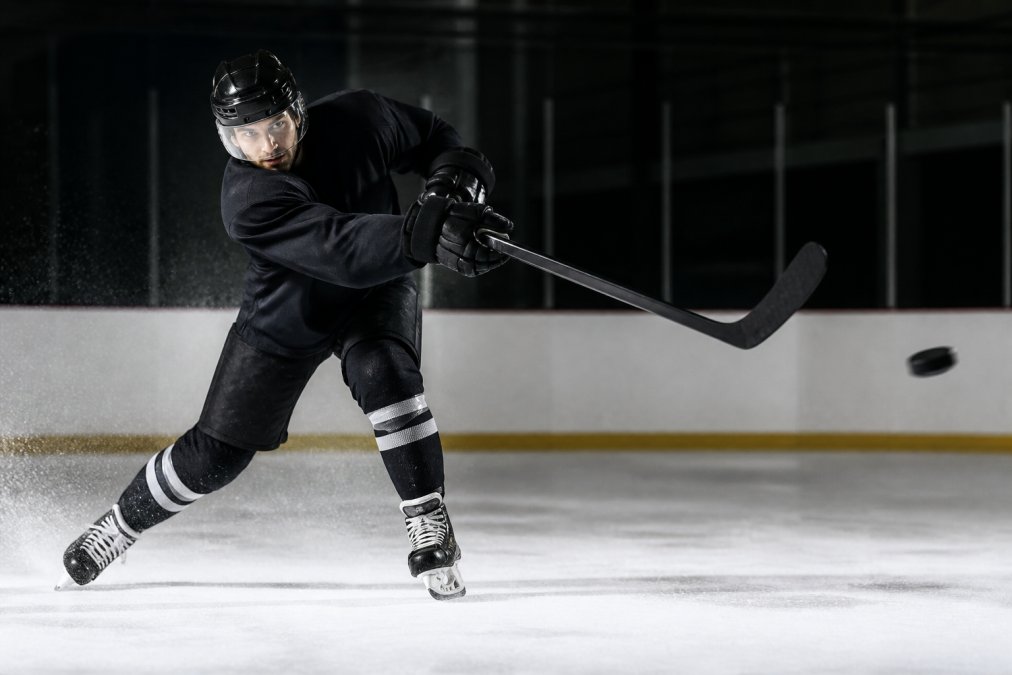
At the top of your backswing, roughly 70% of your weight should be on your back foot (peer-reviewed research). As you begin the downswing, your hips rotate explosively and your weight transfers forward. By contact, most of your weight has moved to your front foot. This transfer happens in a fraction of a second but generates the real power.
The shaft flexes during the backswing as you load it, storing elastic potential energy. On the downswing, the shaft wants to straighten, directing that energy through the blade into the puck. The timing between your hip rotation and arm acceleration is critical: your hips should lead, creating space for your arms to accelerate into. If your arms start moving before your hips finish rotating, you cut your power in half.
Best Stick Flex for Slap Shots and Equipment Optimization
Stick flex is measured in pounds of force required to bend the shaft one inch. A general rule: choose a flex that matches your body weight in pounds. A 180-pound player typically performs best with a 75-85 flex stick, though this is a starting point, not a rule (peer-reviewed research).
The flex point, where the stick bends most, dramatically affects your shot. A mid-kick stick bends in the middle of the shaft, providing balance between velocity and control. A low-kick stick bends near the blade, loading instantly but releasing quickly. For slap shots, a mid or low-kick profile works best because you need rapid loading and explosive release.
Epix Hockey's customizable sticks let you dial in your exact flex, kick point, and shaft specifications. The LightSpeed Low kick profile loads instantly at the bottom of the shaft for maximum velocity. The Neo-Mid profile balances loading and release for all-around performance. With aerospace-grade carbon fiber construction and Elite Fusion Matrix material, you get consistent flex characteristics across every shot.

Shaft material matters significantly. Higher-quality carbon fiber provides better energy return and more consistent flex characteristics. A premium stick with proper flex selection delivers noticeably faster shots than a lower-quality alternative. Blade curve also affects your shot, a curve that matches your natural shooting motion helps you generate more power.
Point of Contact, Follow-Through, and Release Technique
Your blade should strike the puck cleanly, with the stick fully loaded and your weight transferring forward. The contact point should be just slightly ahead of your body, allowing you to transfer maximum energy into the puck.
Your follow-through determines shot consistency and accuracy. After contact, your stick should continue moving toward your target. Don't decelerate at impact; accelerate through it. Your bottom hand should drive forward, extending your arms fully. A complete follow-through also reduces injury risk by distributing force across your entire body.
Your wrists remain firm through contact but can snap slightly after impact to add final acceleration. This snap is subtle, it's the natural completion of your acceleration, not a flick or twist. Timing is everything: your hip rotation must finish before your arm acceleration peaks, and your arm acceleration must finish before your wrist snap. The blade must be square to the puck at contact, directing all your energy into the puck rather than into a curve.
Hockey Shooting Drills for Power and Accuracy
Building slap shot power requires deliberate practice. The most effective drill is repetition shooting: take 20-30 shots from the same spot, focusing on one technical element per session. One day focus on weight transfer, the next on hip rotation, the next on follow-through. This targeted approach builds consistency faster than random shooting.
The one-timer drill develops your ability to shoot off a pass without a wind-up. Have a partner pass the puck to you and shoot immediately. This teaches you to generate power from a compact motion, valuable in game situations where you don't have time for a full wind-up.
Off-ice training builds the strength and explosiveness your slap shot needs. Plyometric exercises like box jumps, medicine ball throws, and rotational core work develop power in your hips and core. Resistance band work strengthens your shoulders and arms. Most elite players spend as much time on off-ice training as they do on-ice practice (peer-reviewed research).
The weighted stick drill builds strength: use a slightly heavier stick (5-10% heavier than your game stick) for 10-15 shots, then switch to your regular stick. The regular stick will feel lighter and faster. Video analysis reveals timing issues you can't see in real-time, record yourself and compare your motion to players you admire.
Drill Type |
Focus |
Frequency |
Duration |
|---|---|---|---|
Repetition shooting |
Technique consistency |
3-4 times weekly |
15-20 minutes |
One-timer |
Game-situation power |
2 times weekly |
10 minutes |
Off-ice strength |
Explosive power development |
3-4 times weekly |
20-30 minutes |
Weighted stick |
Strength building |
1-2 times weekly |
10 minutes |
Video analysis |
Motion refinement |
Weekly |
10-15 minutes |
Accuracy drill |
Power with precision |
2 times weekly |
15 minutes |
Consistency beats intensity. Shooting 20 shots four times a week is more effective than shooting 50 shots once a week. Your nervous system learns through repetition spaced across multiple sessions.
Common Slap Shot Mistakes That Reduce Power
The most common mistake is starting the downswing with your arms instead of your hips. Your arms are smaller and weaker than your hips and core. The sequence must be hips first, then shoulders, then arms.
Another frequent error is excessive wrist action. Wrist snap is a finishing touch, not the power source. Excessive wrist motion reduces velocity by introducing inconsistency and reducing the effective loading of the stick.
Many players don't fully load the stick. Loading requires downward force on the stick during the backswing; the shaft should bend noticeably during your wind-up. Poor weight transfer also kills power, your weight must move from your back foot to your front foot explosively.
Timing issues between hip rotation and arm acceleration are subtle but devastating. If your hips finish rotating before your arms start accelerating, you lose the whip effect. If your arms start too early, they decelerate before the blade reaches the puck.
Incorrect blade angle at contact redirects your power. For maximum power, your blade should be square to the puck. Using a stick that doesn't match your strength is surprisingly common, a stick that's too stiff feels sluggish, while one that's too soft feels whippy and unstable.
Putting It All Together: Your Slap Shot Power Development Plan
Start by filming yourself shooting and watching for common mistakes: arms initiating the motion, insufficient weight transfer, poor timing, or inadequate loading. Fix one issue at a time.
Next, assess your current equipment. If your stick flex doesn't match your strength or body weight, that's your first upgrade. Epix Hockey's customizable sticks let you dial in your exact specifications, choose your flex, your kick point, and your shaft characteristics.
Begin with stance and positioning drills, spending a week focusing solely on proper foot positioning, hand placement, and blade contact. Once these feel natural, move to weight transfer drills, then hip rotation, and finally follow-through and release.
Incorporate off-ice training immediately. Strength and explosiveness don't develop on the ice alone. Practice with intention: shooting 20 shots while focusing on one specific element teaches you far more than shooting 100 random shots. Record yourself regularly and compare your motion to your targets.
Improving your slap shot power isn't just about arm strength, it's about mastering the kinetic chain and matching your equipment to your technique. Epix Hockey's customizable sticks, engineered with aerospace-grade carbon fiber and proprietary kick point technologies like LightSpeed Low and Neo-Mid, are designed to enhance your release speed and accuracy. With personalized flex and shaft specifications tailored to your playing style, you'll unlock the power you've been leaving on the ice. Shop our collection and experience the difference that precision engineering makes.
Frequently Asked Questions
How do I improve slap shot power if I'm a recreational player?
Focus on the fundamentals: proper weight transfer, hip rotation, and hand placement on the shaft. You don't need elite-level fitness to generate more power. Start with 10-15 minutes of dedicated shooting drills 3-4 times per week, emphasizing full follow-through and consistent blade contact with the ice. A stick with the right flex for your strength level also makes a measurable difference without requiring expensive equipment.
What flex should I choose for maximum slap shot power?
Stick flex directly affects how much energy you can store and transfer. Heavier, stronger players typically benefit from stiffer flex (85-100+), while lighter or younger players generate more power with medium flex (70-85). The best stick flex for slap shots matches your body weight and strength—a stick that's too stiff won't load properly, and one that's too soft won't return energy efficiently. Epix Hockey's customizable options let you dial in your exact flex.
What are the most common slap shot mistakes that kill power?
The three biggest mistakes are: (1) Poor weight transfer—staying on your back foot instead of driving through to your front foot; (2) Improper hip rotation—your hips must initiate the shot, not your arms; and (3) Hitting the puck instead of the ice just behind it. Many players also release too early, reducing acceleration through the blade. Finally, using a stick with the wrong flex or poor hand placement on the shaft prevents the kinetic chain from loading properly.
Do dryland exercises really improve slap shot power?
Yes, significantly. Off-ice training builds the explosive power and rotational strength your slap shot demands. Focus on exercises that strengthen your core, hips, and legs: rotational medicine ball throws, single-leg deadlifts, and explosive box jumps. These develop the hip rotation and weight transfer mechanics that transfer directly to ice. The kinetic chain starts from the ground up, so lower-body and core strength are non-negotiable.