

Benefits of Aerospace Grade Carbon Fiber in Hockey
Table of Contents
- Why Aerospace Grade Carbon Fiber Outperforms Standard Materials
- Carbon Fiber Tensile Strength Comparison: Aerospace vs. Standard Grades
- Thermal Stability, Corrosion Resistance, and Durability in Extreme Conditions
- Benefits of Elite Fusion Matrix Material in Hockey Stick Construction
- Hockey Stick Kick Point Technology Explained: Neo-Mid, LightSpeed Low, and Synth Hybrid
- Cost-Benefit Analysis: What Aerospace-Grade Materials Actually Save Operators
- Certification Standards, Supply Chain, and End-of-Life Considerations
- Frequently Asked Questions
Last Updated: August 31, 2026
Why Aerospace Grade Carbon Fiber Outperforms Standard Materials
Aerospace grade carbon fiber delivers structural, measurable performance advantages over standard composites. At Epix Hockey, we engineer sticks using the same material science principles that keep aircraft components intact under extreme mechanical stress.
Aerospace grade carbon fiber is a carbon fiber reinforced polymer (CFRP) manufactured to meet aerospace engineering thresholds: high tensile strength, tight fiber orientation tolerances, controlled resin matrix ratios, and verified thermal stability. Standard commercial-grade carbon fiber uses looser tolerances, lower modulus fibers, and resin systems optimized for cost rather than performance.
A hockey stick shaft experiences bending loads, torsional stress, and impact forces hundreds of times per game. Material that performs inconsistently under fatigue loses stiffness and energy return over time. Aerospace-grade CFRP does not.
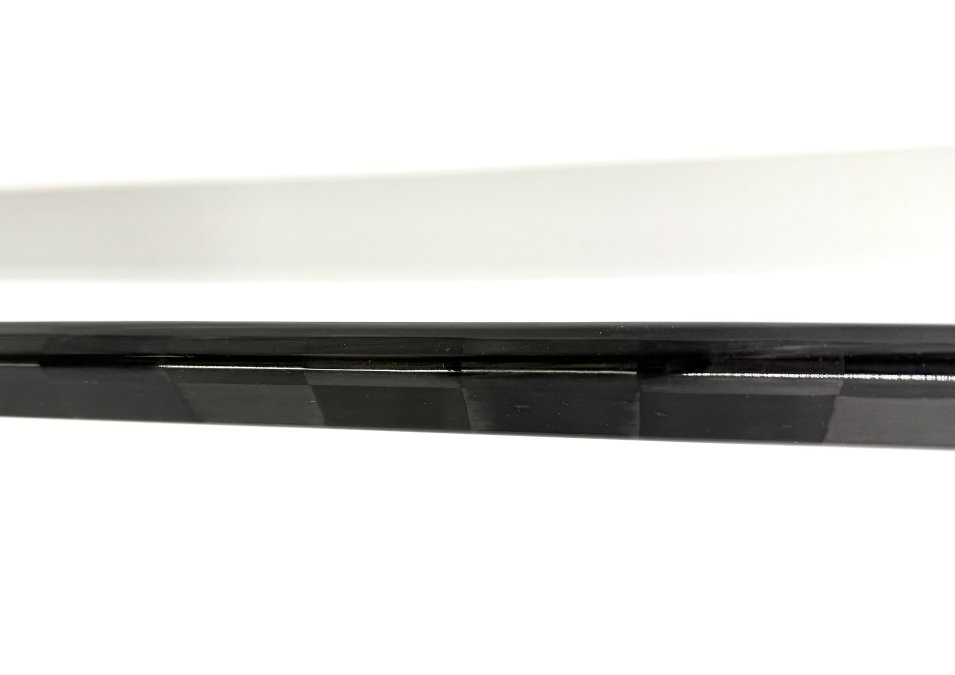
Close-up of a high-performance hockey stick shaft showing the woven carbon fiber texture under bright studio lighting, emphasizing the layered composite construction
Structural Weight Reduction Without Sacrificing Stiffness
The stiffness-to-weight ratio is the defining mechanical advantage of aerospace grade carbon fiber. High-modulus carbon fiber achieves stiffness levels that aluminum or fiberglass cannot match at equivalent weight. For a hockey stick, this means the shaft can be engineered thinner and lighter while maintaining rigidity for consistent puck transfer and shot accuracy.
A lighter stick with equivalent stiffness means faster shot mechanics without energy penalties. According to NASA's materials science research on carbon fiber composites, high-modulus CFRP can achieve stiffness-to-weight ratios up to five times greater than structural steel, which explains why aerospace manufacturing adopted it decades before sports equipment followed.
Fatigue Resistance and Long-Term Structural Integrity
Most equipment failures are fatigue failures, accumulating micro-damage across thousands of loading cycles until structural integrity degrades enough to cause fracture.
Aerospace grade carbon fiber resists delamination and fiber-matrix interface failure under cyclic loading. Fiber orientation is precisely controlled to distribute stress across the composite structure rather than concentrating it at weak points. Standard composites develop stress concentrations earlier and lose mechanical properties faster. An aerospace-grade stick holds its flex rating and energy return characteristics significantly longer through a season than a stick built with lower-grade composites.
Carbon Fiber Tensile Strength Comparison: Aerospace vs. Standard Grades
Tensile strength is often misunderstood. Standard carbon fiber already has impressive tensile strength on an absolute basis. The meaningful comparison is tensile strength relative to weight, where the gap between aerospace-grade and standard grades becomes clear.
Property |
Standard-Grade Carbon Fiber |
Aerospace-Grade CFRP |
|---|---|---|
Tensile Modulus |
230-240 GPa |
290-640 GPa |
Tensile Strength |
3,500-4,500 MPa |
4,500-7,000 MPa |
Fiber Orientation Tolerance |
±3-5° |
±0.5-1° |
Resin Matrix Quality |
Commercial epoxy |
Aerospace-certified epoxy |
Fatigue Resistance |
Moderate |
High |
Delamination Resistance |
Standard |
Enhanced |
Aerospace-grade materials operate at the upper end of mechanical performance because the manufacturing process, including autoclave curing and controlled prepreg layup, produces a more uniform, defect-free composite structure.
How Fiber Orientation and Resin Matrix Systems Drive Performance
Fiber orientation separates aerospace manufacturing from commodity production. In a high-performance hockey stick, multiple plies are oriented at calculated angles, typically 0°, 45°, and 90°, to manage bending stiffness, torsional rigidity, and impact damage tolerance simultaneously.
The resin matrix system is equally critical. Aerospace-certified epoxy resins offer higher glass transition temperatures, better adhesion to carbon fiber surfaces, and superior resistance to moisture absorption compared to commercial-grade resins. According to the ASM International materials handbook on polymer matrix composites, the resin matrix accounts for roughly 30-40% of a composite's mechanical behavior, making resin selection as important as fiber grade for final part performance.
Thermal Stability, Corrosion Resistance, and Durability in Extreme Conditions
Hockey equipment operates in a punishing environment: freezing rink temperatures, repeated moisture exposure, physical impact, and UV exposure. Aerospace grade carbon fiber addresses each condition directly.
Thermal stability in aerospace-grade CFRP means mechanical properties remain consistent across the temperature range a hockey player encounters, from cold outdoor rinks to heated locker rooms. Thermal expansion coefficients are controlled to prevent micro-cracking at fiber-matrix interfaces during temperature cycling.
CFRP does not rust, oxidize, or suffer galvanic corrosion like metal-based alternatives. Aerospace-grade resin systems minimize water absorption at the molecular level, reducing moisture ingress that accelerates delamination. A stick maintains its mechanical properties and performance characteristics across a full season and beyond.
Benefits of Elite Fusion Matrix Material in Hockey Stick Construction
Elite Fusion Matrix material is Epix Hockey's proprietary composite system built on aerospace-grade carbon fiber foundations, engineered specifically for hockey stick performance demands. It represents a specific combination of fiber grade, resin chemistry, layup architecture, and curing protocol optimized for hockey-specific loading conditions.
Elite Fusion Matrix delivers three performance outcomes: enhanced return force through efficient elastic energy storage and release; consistent flex behavior across units rather than variable performance; and impact damage tolerance through layup architecture that distributes impact energy across the composite structure. Manufacturing discipline, controlling layup, resin system, and curing process to aerospace tolerances, produces measurable performance differences rather than marketing claims.
Hockey Stick Kick Point Technology Explained: Neo-Mid, LightSpeed Low, and Synth Hybrid
Kick point is the location along the shaft where maximum flex occurs during a shot. It is one of the most consequential specifications in stick selection because different kick point positions favor different shot types and playing styles. Aerospace grade carbon fiber makes precise kick point engineering possible; standard composites with less controlled mechanical properties produce less predictable flex behavior.
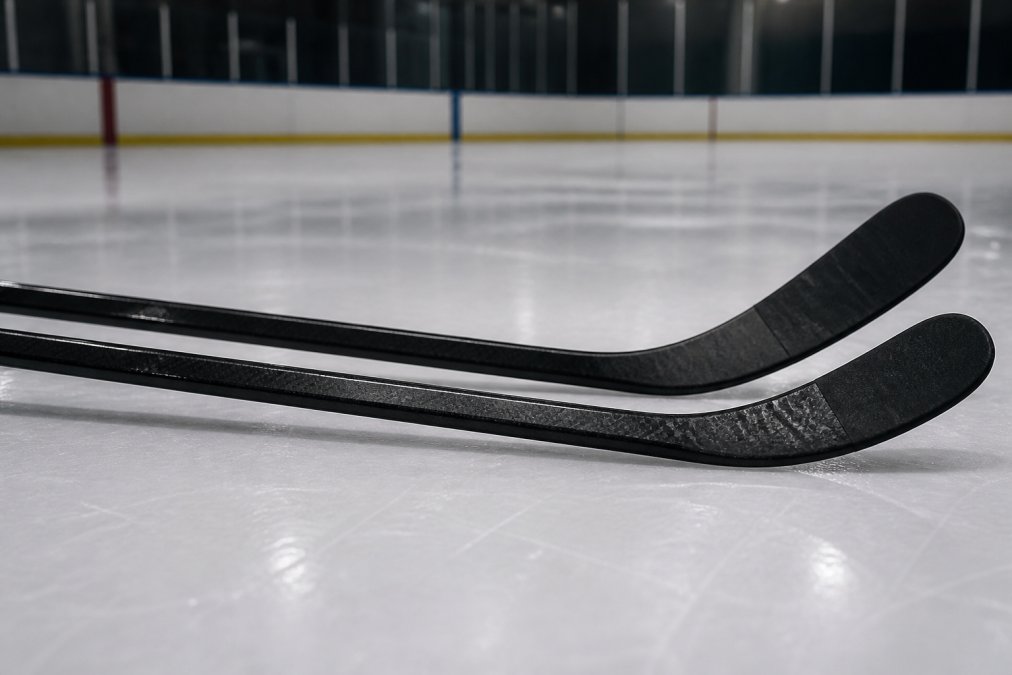
A hockey player loading a slap shot on ice, stick blade pressed to the surface and shaft visibly flexing, captured mid-release in an arena setting
Epix Hockey offers three proprietary kick point technologies:
- Neo-Mid: A mid-shaft kick point optimized for wrist shots and snap shots, producing quick, controlled release with high accuracy.
- LightSpeed Low: A low kick point design engineered for release speed, reducing time between loading and release for players prioritizing shot quickness.
- Synth Hybrid: A variable kick point system combining mid and low flex zones for versatile performance across multiple shot types.
How Aerospace Grade Carbon Fiber Enables Precise Kick Point Engineering
Precise kick point engineering requires predictable, consistent mechanical behavior. Because aerospace-grade CFRP has tightly controlled fiber orientation and modulus values, engineers can design specific flex zones by varying layup angles and ply thickness at defined locations. Standard composites with wider manufacturing tolerances produce shafts where actual flex behavior deviates from design intent, shifting the kick point and drifting the flex rating. Aerospace-grade materials eliminate that variability.
Cost-Benefit Analysis: What Aerospace-Grade Materials Actually Save Operators
Aerospace-grade carbon fiber hockey sticks cost more upfront than standard composite alternatives. The cost-benefit case, however, is built on cost per performance unit over time, not price per stick.
Standard composite sticks lose mechanical properties faster under fatigue, requiring earlier replacement and eroding the apparent cost advantage of lower initial price. Aerospace-grade CFRP maintains flex rating and energy return characteristics through more loading cycles, extending useful service life.
Epix Hockey sticks deliver an average 3.2% increase in release speed and 4.3% improvement in accuracy compared to baseline. For competitive players, these margins translate to real outcomes in game situations. For players competing at any level, aerospace-grade equipment investment can be justified.
Certification Standards, Supply Chain, and End-of-Life Considerations
Genuine aerospace grade carbon fiber is produced under quality management systems certified to standards such as AS9100, the aerospace industry's quality management framework. According to Standards Council of Canada guidance on aerospace quality management, AS9100 certification requires documented process controls at every stage of production, from raw material receipt through final inspection.
When a hockey stick manufacturer claims aerospace-grade materials without tracing fiber to a certified supplier and controlled production process, the claim is marketing language rather than technical specification. Epix Hockey sources materials through a supply chain maintaining traceability to aerospace manufacturing standards, producing consistent, repeatable performance results.
Carbon fiber composites present a genuine recyclability challenge. CFRP is not recyclable through standard municipal programs. Emerging processes like pyrolysis and solvolysis can recover carbon fiber, but these are not yet widely accessible at the consumer level. Longer service life reduces disposal frequency, which is the most meaningful current advantage of aerospace-grade materials from a lifecycle perspective.
Consideration |
Standard Composite Stick |
Aerospace-Grade CFRP Stick |
|---|---|---|
Service Life |
Shorter under high-cycle fatigue |
Extended, maintains flex rating longer |
Flex Consistency |
Variable across units |
Controlled to specification |
Certification Traceability |
Often absent |
Traceable to aerospace supply chain |
End-of-Life Recyclability |
Limited |
Limited (industry-wide challenge) |
Performance Longevity |
Degrades faster |
Stable across season |
Cost Per Season |
Lower upfront, higher replacement rate |
Higher upfront, lower replacement rate |
Serious players face a real equipment problem: the market is full of sticks claiming high performance but delivering inconsistent results because materials and manufacturing discipline do not match marketing claims. Epix Hockey was built to close that gap, using aerospace grade carbon fiber, the Elite Fusion Matrix material system, and proprietary kick point technologies validated through third-party testing. The result is a stick engineered to perform to specification, not just to a price point. Visit epixhockey.com and SHOP COLLECTION to find your flex, kick point, and curve combination.
Frequently Asked Questions
Q: How does aerospace grade carbon fiber differ from standard carbon fiber?
A: Aerospace grade carbon fiber, often called CFRP (carbon fiber reinforced polymer), is manufactured to tighter tolerances with higher-modulus fibers, controlled fiber orientation, and certified resin matrix systems. Standard commercial carbon fiber uses lower-grade precursors and less precise layup processes. The result is a measurable gap in tensile strength, stiffness-to-weight ratio, and fatigue resistance. In hockey sticks, that gap translates directly into more consistent energy return, a crisper flex cycle, and a longer service life under repeated high-impact loading.
Q: Does aerospace grade carbon fiber actually improve energy transfer in a hockey stick?
A: Yes. The high stiffness-to-weight ratio of aerospace grade carbon fiber means the shaft stores and releases energy more efficiently through each flex cycle. When the stick loads during a shot, the CFRP structure compresses with minimal energy loss, then snaps back rapidly. Epix Hockey's third-party testing recorded an average 3.2% increase in release speed and a 4.3% improvement in accuracy compared to baseline sticks, results that reflect the material's superior mechanical properties rather than marketing language.
Q: What are the main pros and cons of carbon fiber in hockey equipment?
A: Pros: exceptional tensile strength at very low weight, high fatigue resistance over thousands of flex cycles, corrosion resistance that eliminates rust and degradation from ice and moisture, and precise kick point engineering that standard materials cannot replicate. Cons: impact damage tolerance requires careful construction because CFRP can delaminate from sharp point impacts, and the material costs more to manufacture than fibreglass or lower-grade composites. Aerospace grade layup techniques and quality resin matrix systems address the delamination risk, which is why material certification and construction method matter.
Q: Is a fully customized aerospace grade carbon fiber stick worth it for a recreational player?
A: For a recreational player who shoots frequently and wants a stick that lasts, the durability and consistent flex response of aerospace grade carbon fiber deliver real value. The performance gap is most obvious in shot release and stick feel, but the longer service life also means fewer replacements over a season. Customizing flex and kick point to your actual shooting style, rather than accepting a generic off-the-shelf spec, removes one variable from inconsistent shot mechanics. Visit the Epix Hockey site to check current pricing and find the configuration that fits your game.