

Understanding Hockey Stick Kick Point: A 2026 Guide
Table of Contents
- What Is a Hockey Stick Kick Point?
- How Kick Point Affects Energy Transfer and Shot Performance
- Low vs Mid Kick Point Hockey Stick: Which One Suits Your Game?
- Hockey Stick Flex Guide: How Stiffness and Kick Point Work Together
- How to Choose a Hockey Stick Kick Point for Your Position and Skill Level
- Find Your Match: A Kick Point Decision Framework
- Epix Hockey's Proprietary Kick Point Technologies
- Frequently Asked Questions
Last Updated: August 31, 2026
What Is a Hockey Stick Kick Point?
A hockey stick kick point is the zone along the shaft where the stick bends most under load during a shot. When you press your bottom hand into the ice and pull with your top hand, the shaft compresses. The location of that maximum flex point determines how energy is stored, released, and transferred to the puck.
The term "kick point" and "flex point" are used interchangeably across the industry. Three primary positions exist: low (near the blade), mid (roughly midshaft), and high (toward the top hand). Variable and hybrid designs blend two zones into one shaft. Each creates a different shot experience, and matching the right position to your mechanics is what separates a stick that feels natural from one that fights you every shift.
How Kick Point Affects Energy Transfer and Shot Performance
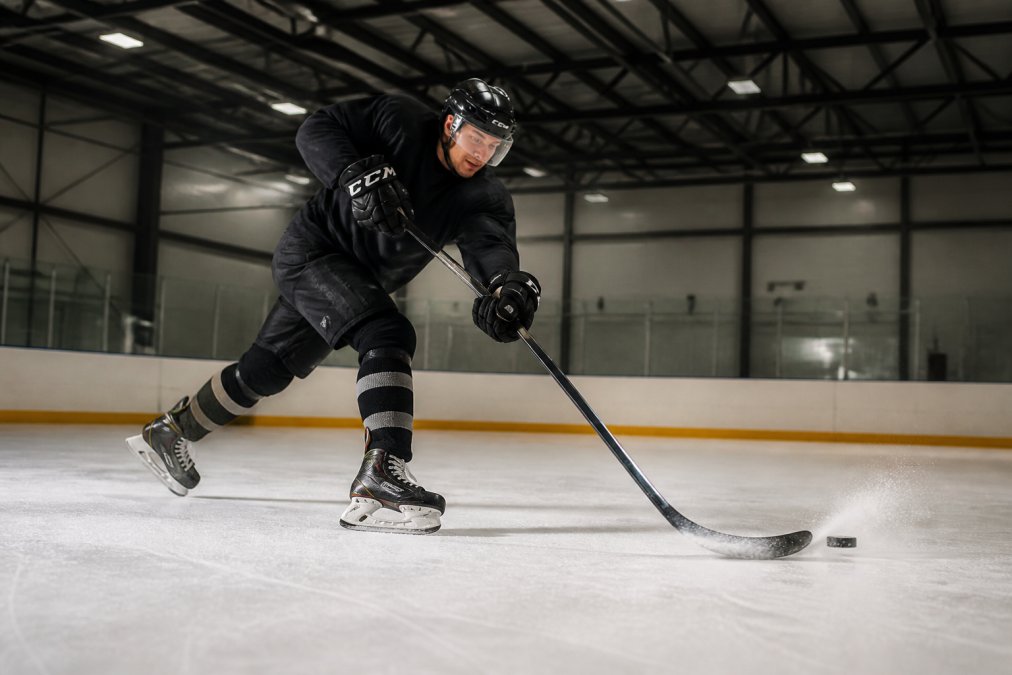
The shaft acts like a spring: it stores kinetic energy during the loading phase and releases it at puck contact to accelerate the shot. The loading phase begins the moment your bottom hand applies downward pressure to the shaft. The stick compresses against the ice, bending at its engineered kick point. On release, that stored energy snaps back, adding velocity to the puck beyond what your muscles alone could generate.
The Physics of Loading and Snap
Picture the shaft as a loaded bow. The archer draws the string, storing energy in the limbs. Release the string and that energy transfers instantly to the arrow. A hockey stick works the same way, with one critical difference: the location of maximum bend controls when that energy releases relative to puck position.
A low kick point loads quickly and near the blade, with snap happening fast while the puck is still in the shooting zone. A high kick point requires more shaft travel before maximum compression, taking longer but storing more energy when paired with a stiffer shaft. Mid kick point sits between these extremes, balancing load speed with energy volume. Torsional rigidity also matters, a shaft that twists during loading bleeds energy sideways instead of forward.
Launch Angle, Trajectory, and Puck Release
Kick point position influences launch angle as much as shot velocity. A low kick point keeps the blade on the ice longer during release, allowing players to keep the puck low, ideal for snap shots aimed at the short side. A mid kick point lifts the puck slightly more, suiting natural wrist shot trajectories aimed at the upper net. High kick point designs launch the puck at a steeper angle because the shaft unloads higher up the stroke.
According to Hockey Canada's player development resources, shooting mechanics and equipment selection are both cited as factors in youth player development outcomes. Getting the launch angle right for your shot type starts with the kick point.
Low vs Mid Kick Point Hockey Stick: Which One Suits Your Game?
Low Kick Point: Built for Quick Release
A low kick point loads near the heel of the blade, reaching maximum compression faster and with less weight transfer required. The practical result is a quicker release. Players who take snap shots off the pass, shoot off one foot, or operate in tight spaces around the net benefit most from this design.
Forwards who play on the perimeter and shoot in stride typically gravitate toward low kick point sticks. The shaft snaps before a defender can read the release. The limitation is power ceiling, because the loading zone is compact and close to the blade, there is less shaft length available to store energy.
Mid Kick Point: Built for Power
A mid kick point bends at roughly the center of the shaft, requiring more deliberate weight transfer but rewarding that effort with greater stored energy. Slap shots, one-timers from the blue line, and power shots from the perimeter are where mid kick point designs earn their reputation.
Defensemen who quarterback the power play and shoot from distance are the textbook mid kick point user. The loading phase is longer, giving the shaft more time to compress fully before releasing. That full compression translates to higher shot velocity.
High Kick Point and Variable Hybrid Designs
High kick point designs are less common in modern stick construction but remain relevant for players with traditional slap shot mechanics and significant strength. Variable and hybrid kick point designs solve a different problem by engineering two flex zones into a single shaft, allowing the stick to adapt to the situation rather than locking you into one shot type.
As documented in National Strength and Conditioning Association research on sport-specific mechanics, force application patterns vary significantly between individual athletes. Hybrid kick point designs acknowledge this reality rather than forcing every player into a single mechanical template.
Hockey Stick Flex Guide: How Stiffness and Kick Point Work Together
Flex rating and kick point position work as a system. Getting one right while ignoring the other produces a stick that underperforms for your build and style.
Choosing the Right Flex Number
Flex rating describes how much force is required to bend the shaft one inch. The general starting point: match your flex number to roughly half your body weight in pounds. A player weighing 180 lbs starts around a 90 flex. Shooting style, strength, and position all shift the ideal number.
A low kick point stick at a high flex rating defeats the purpose of the low kick point. The shaft is too stiff to load quickly near the blade. Conversely, a soft flex with a high kick point may load unpredictably. The practical pairing that works for most players: low kick point with a flex 10-15 points softer than your standard, and mid kick point at your standard flex or 5 points stiffer.
Kick Point vs. Blade Curve Synergy
Blade curve directly interacts with kick point to shape puck trajectory and control. A blade with a deep, heel-to-mid curve paired with a low kick point keeps the puck on the blade longer during release, amplifying the low-trajectory advantage. A toe curve with a mid kick point tilts the puck upward earlier, helping players lift the puck on wrist shots without extra wrist action.
Mismatching blade curve and kick point creates mechanical conflict. Understanding that blade and shaft are one system, not two separate components, is the insight that separates well-matched equipment from poorly-matched gear.
Hockey Equipment Certification Council technical standards for stick construction provides the framework manufacturers use when engineering shaft and blade integration.
How to Choose a Hockey Stick Kick Point for Your Position and Skill Level
Forwards and Defensemen: Position-Based Recommendations
Forwards who score from close range, operate in traffic, or rely on quick release should default to a low kick point. Wingers who shoot in stride and centers who receive passes in the slot both benefit from this profile.
Defensemen who shoot from the point, activate on the power play, or rely on slap shots should start with a mid kick point. The power advantage compounds over a full game when every shot from the blue line carries maximum velocity.
Two-way players are strong candidates for hybrid kick point designs, giving genuine performance in both shooting contexts.
Youth, Recreational, and Elite Players
Youth players benefit most from a low kick point paired with a softer flex. Developing players rarely have the strength or technique to fully load a mid or high kick point. A low kick point with appropriate flex lets young players experience proper loading and release mechanics without fighting the shaft.
Recreational players follow similar logic. A stick that loads easily and releases predictably builds confidence and consistency. Elite players have the strength and mechanics to exploit any kick point position, often using different sticks for practice versus game situations.
Find Your Match: A Kick Point Decision Framework
Use this framework to match your profile to the right hockey stick kick point before you order.
| Player Profile | Recommended Kick Point | Flex Adjustment | Primary Shot Type |
|---|---|---|---|
| Forward, quick release, slot shooter | Low | 5-10 softer than standard | Snap shot, wrist shot |
| Forward, perimeter shooter, one-timer | Mid | Standard or 5 stiffer | One-timer, power wrist shot |
| Defenseman, point shot, slap shot | Mid | Standard or 5 stiffer | Slap shot, one-timer |
| Defenseman, pinching, quick release | Low | Standard | Snap shot, wrist shot |
| Youth player, developing mechanics | Low | 10-15 softer than standard | Wrist shot, snap shot |
| Two-way player, multiple shot types | Hybrid/Variable | Standard | All shot types |
| Power forward, heavy shot, strong build | Mid or High | 5-10 stiffer than standard | Slap shot, power shot |
Work through these four questions before selecting:
- Where do most of your goals come from? (Slot = low, point = mid)
- What is your primary shot? (Quick release = low, slap shot = mid/high)
- How would you describe your shooting stroke? (Short and fast = low, long and deliberate = mid/high)
- Do you need one stick to do everything, or can you specialize? (Everything = hybrid, specialized = low or mid)
If your answers split evenly between low and mid, start with a hybrid design. If three or four answers point to one category, that category is your match.
Epix Hockey's Proprietary Kick Point Technologies
Epix Hockey engineers three distinct kick point systems, each built on aerospace-grade carbon fiber and the Elite Fusion Matrix material platform. These are engineered differences in fiber layup, shaft taper, and flex zone placement that produce measurable performance outcomes.
The LightSpeed Low is engineered for the quick-release player. Third-party testing validates an average 3.2% increase in release speed and 4.3% improvement in accuracy compared to baseline measurements.
The Neo-Mid targets power shooters and defensemen. The mid-shaft flex zone stores more energy during the loading phase, with enhanced return force on every shot.
The Synth Hybrid addresses players who refuse to compromise. Dual-zone engineering creates two distinct loading regions in a single shaft, performing well across multiple shot types.
All three designs are available with fully customizable specifications including flex rating, blade curve, and shaft dimensions. Customization is the baseline expectation at Epix Hockey.
Most players spend years shooting with a stick that does not match their mechanics, never realizing that the equipment is working against them. Matching your kick point to your shooting style is one of the highest-use adjustments you can make without changing anything about how you play. Epix Hockey's LightSpeed Low, Neo-Mid, and Synth Hybrid technologies give you the tools to make that match precisely, backed by third-party testing and fully customizable specifications. SHOP COLLECTION and find the setup that fits how you actually shoot.
Frequently Asked Questions
What is the difference between a low, mid, and high kick point?
A low kick point flexes near the blade, releasing the puck faster off the stick for quick snap shots and wrist shots. A mid kick point bends in the middle of the shaft, storing more energy for powerful slap shots. A high kick point flexes near the top hand, maximizing energy transfer on full-wind slap shots. Each location changes where the shaft loads, which directly affects shot velocity, launch angle, and the style of shot that feels most natural.
How does stick flex interact with the kick point during a shot?
Flex and kick point work together: flex determines how much the shaft compresses under pressure, while the kick point determines where that compression happens. A low-flex stick (softer) with a low kick point produces a fast, easy release ideal for lighter players or those with a quick-release shooting style. A stiffer shaft with a mid kick point demands more force to load but returns more energy on release, suiting players who take hard slap shots and generate significant weight transfer through the bottom hand.
Which kick point is best for a defenseman versus a forward?
Defensemen who rely on slap shots from the blue line typically benefit from a mid or high kick point, which stores maximum energy in the shaft for a power shot. Forwards who need to get shots off quickly in tight spaces generally prefer a low kick point for its fast release. That said, playing style matters more than position alone. A defenseman with a quick-release wrist shot, or a power forward who winds up from the circle, should choose based on their dominant shot type rather than position label.
How does a kick point affect my release speed and accuracy?
The kick point changes when and how the shaft snaps back during puck release. A low kick point releases energy earlier in the shooting motion, shortening the time the puck stays on the blade and producing a quicker, more deceptive release. A mid kick point releases energy later, generating higher shot velocity on slap shots. Accuracy is influenced by torsional rigidity and blade alignment at the moment of release. Matching the kick point to your natural shooting mechanics reduces unwanted blade twist, improving where the puck actually goes.
Can you explain the concept of a hybrid kick point on a hockey stick?
A hybrid or variable kick point uses a shaft taper and construction that allows the stick to flex at multiple points depending on the shot type. During a snap shot, the lower shaft loads first for a quick release. During a full slap shot with a longer loading phase, the flex travels higher up the shaft to generate more power. Hybrid construction suits players who take a variety of shots in a game and want one stick to handle both quick-release situations and power-shot opportunities without switching sticks.
How do I know what kick point to order if I can't hold the stick first?
Start with your dominant shot type. If you score most often on snap shots and wrist shots, choose a low kick point. If your best scoring chance is a hard slap shot from distance, go mid or high. Then factor in your flex: your stick should flex noticeably under your shooting load without bottoming out. Epix Hockey's customizable specifications let you dial in both kick point and flex before you order, and the team can guide your selection based on your position, weight, and shooting style.
This article was written using GrandRanker