

Recreational vs Elite Hockey Sticks: What's the Difference?
Table of Contents
- What Separates Recreational and Elite Hockey Sticks
- Recreational vs Elite Hockey Sticks: Quick Comparison
- Materials: Wood, Fiberglass, and Carbon Fiber Construction
- Hockey Stick Flex Guide: Finding Your Number
- Hockey Stick Kick Point Explained: Low, Mid, and Hybrid
- Weight, Durability, and the Longevity Trade-off
- The Mid-Range Sweet Spot: Where Value Meets Performance
- Frequently Asked Questions
Last Updated: September 10, 2026
What Separates Recreational and Elite Hockey Sticks
The gap between recreational versus elite hockey sticks comes down to three things: material composition, weight, and how precisely the shaft loads energy into your shot. Recreational sticks prioritize durability and cost. Elite sticks prioritize release speed and puck feel, and they charge accordingly.
At Epix Hockey, we build sticks for players across that entire spectrum, and we hear the same question constantly: is the upgrade actually worth it? Below, we break down construction, flex, kick point, and weight so you can decide where your money belongs.
A definition worth anchoring to: an elite hockey stick is a composite shaft engineered with high-modulus carbon fiber, tuned flex, and a specific kick point to maximize energy transfer on release.
Recreational vs Elite Hockey Sticks: Quick Comparison
The table below is the fastest way to see where the tiers actually diverge. The numbers are typical senior-stick ranges, not absolutes; construction varies by model and brand.
Feature |
Recreational |
Mid-Range (Performance) |
Elite |
|---|---|---|---|
Primary material |
Wood or fiberglass blend |
Carbon and fiberglass mix |
|
Weight (senior) |
Heavier, around 500g+ |
Roughly 400-450g |
350-400g |
Flex options |
Few, often fixed |
Several |
Fine-tuned increments |
Kick point |
Basic mid |
Mid or low |
Low, mid, or hybrid |
Durability |
High |
Moderate to high |
Moderate |
Typical lifespan (2x/week player) |
Multiple seasons |
1-2 seasons |
Under a season for heavy shooters |
Best for |
Beginners, street hockey |
Most competitive players |
Advanced and elite skaters |
The Weight-to-Price Ratio Nobody Publishes
Weight is the single metric elite players chase, and it is also where the money curve bends hardest. A common pattern in the category:
- Recreational (500g+): heavy, cheap, and nearly indestructible. The weight penalty shows up in shot speed and hand fatigue over a full game.
- Mid-range (400-450g): the biggest single drop in weight per dollar. You shed roughly 50-100 grams versus recreational without paying the elite premium.
- Elite (350-400g): you are now paying a steep premium to shave the last 50 grams. That final drop is the most expensive weight you will ever remove from a stick.
That is the diminishing-returns curve in one line: the first 100 grams come cheap, the last 50 come dear. Most recreational and intermediate players will not feel the difference between 400g and 350g in a game situation. Advanced players chasing release speed will.
Why the Mid-Range Tier Wins on Value
Most guides frame this as a binary, recreational or elite. The reality is that the performance tier in the middle is where the value lives for beer-league and competitive rec players. The jump from recreational to mid-range buys you real carbon construction, tuned flex, and a proper kick profile. The jump from mid-range to elite buys you a lighter shaft and a marginally faster release. That second jump is where the money stops working as hard.
How to Read This Table for Your Game
Match the tier to your shot volume and level of play, not to your ego:
- Play once a week, mostly for fun? Recreational or entry mid-range. Durability matters more than grams.
- Play twice a week in a competitive league? Mid-range. You get carbon feel and tuned flex without the fragile elite build.
- Play high-level hockey and shoot hundreds of pucks a week? Elite. You will actually use the release speed and lighter weight.
If you are between tiers, the honest answer is usually the lower one; a stick you can fully load beats a stiffer, lighter stick you cannot.
Materials: Wood, Fiberglass, and Carbon Fiber Construction
Wood sticks still exist, and they still have a place. A wood core with an ABS blade handles street hockey, pond rinks, and driveway abuse better than anything carbon can. The trade-off is weight and consistency: wood absorbs energy rather than returning it, so your shot loses velocity.
Composite construction changed the category. Carbon fiber layers are laid at specific angles so the shaft stores energy during the load and snaps back on release. Fiberglass blends sit in the middle, cheaper and more forgiving, but with less pop.
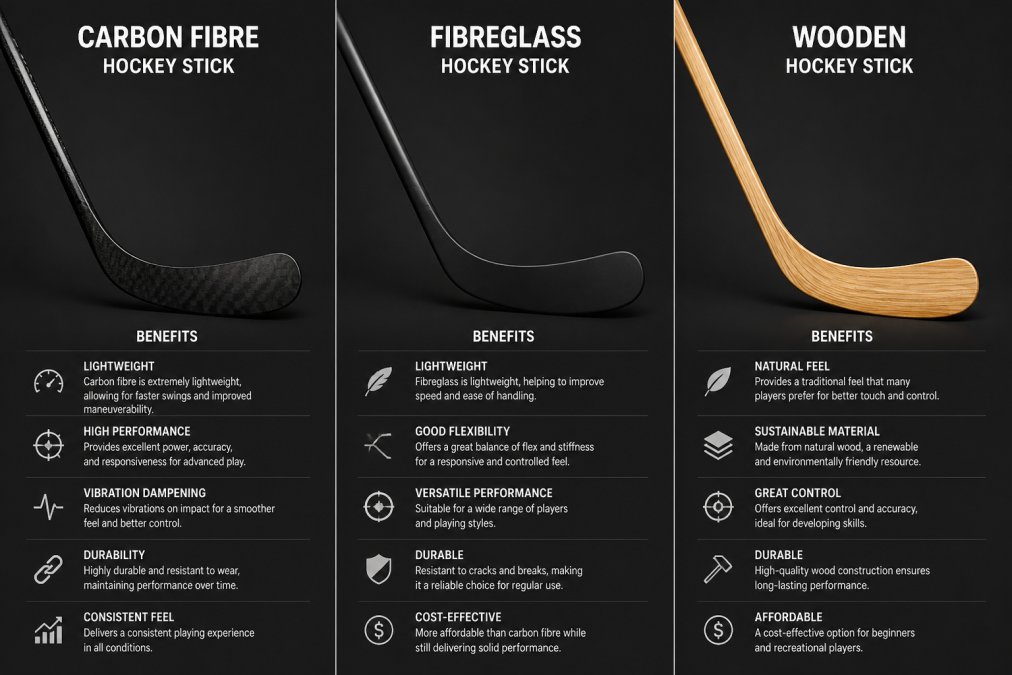
Epix Hockey uses aerospace-grade carbon fiber and our Elite Fusion Matrix material, which is where the performance difference lives. According to Epix Hockey's internal testing, their sticks achieve an average 3.2% increase in release speed and 4.3% improvement in accuracy over standard composite builds.
Hockey Stick Flex Guide: Finding Your Number
Flex rating measures how much force it takes to bend the shaft, expressed as a number roughly tied to body weight. A common starting point is half your body weight in pounds, rounded to the nearest five. A 170-pound player typically lands around 85 flex.
That rule is a starting point, not gospel. It assumes average strength and an average shot. It does not account for how hard you actually lean into the shaft, how often you shoot, or what kind of shot you take. Treat it as a first guess, then adjust.
How Flex Actually Loads
A stick only returns energy if you can bend it. When you lean into a shot, the shaft stores energy during the load and snaps back on release. If the flex is too stiff for your strength, you never reach the kick point, and the stick plays like a board, less pop than a cheaper stick you can actually bend. If the flex is too soft, the shaft bottoms out early and you lose accuracy and control on hard shots.
The goal is a flex you can load fully with your normal shooting motion, not your maximum effort.
Flex by Tier and Level
Flex ranges shift with the build tier and the player's size and level:
- Junior: roughly 40-50 flex. Built for younger and lighter players still developing strength.
- Intermediate: roughly 55-67 flex. A bridge for teens and smaller adults.
- Senior: 70 flex and up, commonly to 100+ for strong shooters.
Within senior, the practical split is:
- 70-77 flex: quick-release players, smaller or lighter adults, and anyone who wants an easy load for snap shots.
- 85-87 flex: the most common adult range. A balanced middle for players of average strength.
- 95-100+ flex: strong, heavy shooters who take a lot of slap shots and can genuinely bend a stiff shaft.
Matching Flex to Your Shot Type
Flex is not just about weight, it is about how you shoot:
- Snap and wrist shots: a whippier flex loads faster and releases quicker. If your game is quick releases in traffic, lean softer.
- Slap shots and one-timers: a stiffer flex holds up under a heavy lean and keeps the blade from twisting. If you wind up and lean in, lean stiffer.
- A bit of everything: stay near the half-bodyweight number and adjust one step softer if you are unsure.
The Between-Numbers Rule
If you are between two flex ratings, go softer. You will load the shaft more easily, and an under-loaded shaft is a bigger performance problem than a slightly soft one. A stick you can bend fully will outshoot a stiffer stick you cannot.
When to Change Your Flex
Your flex number is not permanent. Growing players, players adding strength in the gym, and players changing their shot mix should all revisit it. A common pattern is to move up one flex step after a season of strength training, or down one step when switching to a quicker, more wrist-shot-heavy style. If your shot feels like it is fighting the stick, the flex is probably wrong.
Hockey Stick Kick Point Explained: Low, Mid, and Hybrid
Kick point is where the shaft bends and releases energy, and it dictates what kind of shot the stick favors.
A low kick point loads near the bottom of the shaft. It suits quick wrist shots and snap shots where you don't have time to wind up. Epix Hockey's LightSpeed Low profile on the DARKMATTER line loads instantly at the bottom of the shaft for exactly this reason.
A mid kick point loads through the middle of the shaft. It's the balanced option, better for slap shots and one-timers where you have room to lean into it. The Neo-Mid profile on our ICECOLD line loads progressively through the mid-shaft for a controlled, accurate release.

A hybrid kick point blends both, giving you a compromise for players who take a bit of everything.
Weight, Durability, and the Longevity Trade-off
Lighter sticks cost more and break more. That's the trade-off nobody puts on the packaging.
Senior elite sticks now sit around 350-400 grams. Epix Hockey's DARKMATTER Senior weighs 350 grams; the Intermediate is 315 grams; the Junior is 285 grams. Getting weight down means thinner walls and less material, which reduces impact tolerance.
Material fatigue is real. Every flex cycle stresses the carbon layup, and a stick used for slap shots every shift ages faster than one used for quick releases. This is why pro-stock sticks get replaced so often.
The Mid-Range Sweet Spot: Where Value Meets Performance
Most players should buy mid-range, and it isn't close.
The jump from recreational to mid-range buys you real carbon construction, tuned flex, and a proper kick profile. The jump from mid-range to elite buys you a lighter shaft and marginally faster release. That second jump is where diminishing returns hit hardest. You're paying a premium for grams and a fraction of a second.
What most guides miss is the weight-to-price ratio. Dropping from 450 grams to 350 grams costs a significant premium, and most recreational and intermediate players won't notice the difference in a game situation. Advanced players chasing release speed will.
That's the case for a customizable build. Epix Hockey lets you specify flex, curve, and shaft characteristics. If you're a growing player whose style is still changing, ordering to your current specs beats guessing at a fixed retail model.
Frequently Asked Questions
What are the primary material differences between recreational and elite hockey sticks?
Recreational sticks typically use wood or fiberglass-reinforced construction, which keeps costs down but adds weight. Elite hockey sticks are built with carbon fiber, often aerospace-grade, layered at specific angles to control how the shaft loads and returns energy. That layering is what drives shot velocity and puck feel. Some elite models also blend in materials like titanium or boron fibers to fine-tune stiffness and durability without adding grams.
Do elite hockey sticks break more easily than recreational models?
Not necessarily. A well-built carbon fiber stick can outlast a wood one because it resists moisture and doesn't splinter the same way. The weak points are usually the blade and the taper, not the shaft material itself. Cheaper composites that use less precise layering can fail earlier. Construction quality matters more than whether the stick is labeled recreational or elite.
What flex should a 10 year old use?
Most 10-year-olds fall in the 40 to 50 flex range, but weight matters more than age. A good rule is to pick a flex roughly half the player's body weight in pounds. If a young player can't flex the stick at all when leaning into a shot, it's too stiff. Junior sticks often start at 30 flex and go up from there, so there's room to grow into a stiffer option.
Is a higher price point always better for a recreational hockey player?
No. The performance gap between a mid-range composite and a top-tier elite stick is small for most recreational players. You're often paying for marginal weight savings and pro-level finish, not a dramatic jump in shot speed. A mid-range stick with the right flex and kick point will outperform an expensive stick with the wrong specs every time.