

Understanding Hockey Stick Blade Patterns (2026 Guide)
Table of Contents
- Blade Curve Basics: Depth, Face Angle, and Loft
- Toe vs Mid Curve Hockey: Which Pattern Type Fits Your Game
- Hockey Stick Lie Explained: Why Shaft Angle Changes Everything
- How Blade Patterns Change Puck Control and Shooting Accuracy
- How to Choose a Hockey Stick Curve for Your Position and Skill Level
- Blade Wear, Maintenance, and When to Replace Your Stick
- Conclusion
- Frequently Asked Questions
Last Updated: September 20, 2026
Blade Curve Basics: Depth, Face Angle, and Loft
Understanding hockey stick blade patterns starts with three measurements that shape every shot you take: blade depth, face angle, and loft. This guide from Epix Hockey breaks down how each one changes puck behavior, and why two sticks with the same curve name can still feel completely different in your hands.
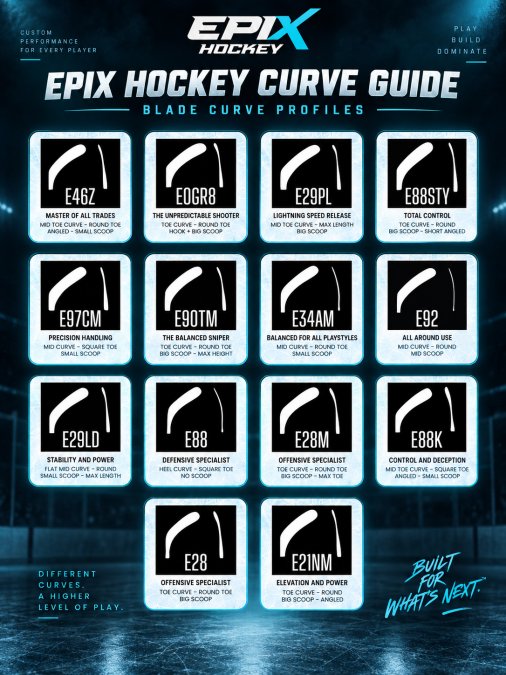
Diagram illustrating how blade patterns affect curve depth, face angle, and loft on a hockey stick.
Toe vs Mid Curve Hockey: Which Pattern Type Fits Your Game
Toe curves place the bend near the end of the blade. Mid curves place it in the center. Heel curves sit closer to the shaft. Each location changes where the puck leaves your blade and how the stick loads during a shot.
Heel Curves: The Defensive and Playmaking Option
Heel curves reward patience. The puck sits deeper toward the shaft, so you get more time to settle it before releasing. Defensemen who move the puck quickly up the wall tend to prefer this shape because it keeps passes flat and predictable. The tradeoff is a slower release on quick snap shots from the slot.
Hockey Stick Lie Explained: Why Shaft Angle Changes Everything
Lie is the angle between the shaft and the blade, expressed as a number (typically 4 to 8, in half-step increments). It decides how much of your blade actually touches the ice when you are in your natural stance. A stick with the wrong lie forces you to compensate with your stance, your grip, or your skating posture, and that compensation quietly costs you accuracy on every shot.
The Tape Test: Diagnosing Your Lie in 30 Seconds
You do not need a fitting bay to check this. Tape the bottom of your blade, take 10 to 15 shots or hard strides on clean ice, then look at the wear pattern on the tape:
- Wear concentrated at the heel, your lie is too low for your stance. The toe is riding up.
- Wear concentrated at the toe, your lie is too high. The heel is riding up.
- Even wear heel to toe, your lie is correct for how you actually skate and shoot.
Why Lie Matters More Than Most Players Think
Lie is not a standalone spec, it interacts with curve depth and your shooting mechanics. A deep curve paired with the wrong lie is the worst combination, because the blade is already cupping the puck hard and now it is also tilted off the ice. The puck catches the toe or heel instead of rolling cleanly along the face, and your release point becomes unpredictable.
Who Needs to Pay Closest Attention
Getting lie right matters most for three groups:
- Shorter players, a stock senior stick is built for an average-height player, so shorter skaters often need a lower lie than what comes off the rack.
- Players with an unusual skating stance, a wide, low stance or a very upright posture both change the effective lie you need.
- Junior and intermediate players, these age groups frequently need a lower lie than stock senior sticks offer, and forcing a senior lie teaches bad habits early.
If you fall into any of these groups, lie is the first spec to sort out, before curve depth or face angle. A stick that sits flat on the ice is the foundation everything else builds on.
How Blade Patterns Change Puck Control and Shooting Accuracy
Puck control and shooting accuracy come down to how much blade surface meets the puck and how long the puck stays on that surface. A deeper curve cups the puck, which stabilizes stickhandling in traffic but can cause shots to sail high. A flatter curve gives you a more predictable release but less grip on the puck. That is the standard explanation, but it stops short of the mechanism that actually decides where your shot goes.
The Physics of Loft, Spin, and Trajectory
When you release a wrist shot, the puck rolls from heel to toe along the curved blade face. That roll is not incidental, it is what imparts backspin. Backspin does two things: it stabilizes the puck in flight (the same way a spiral pass holds its line), and it creates a small amount of lift as the puck travels through the air.
How Curve Depth Changes Your Release Window
Curve depth determines how long the puck stays on the blade before it leaves. A deep curve holds the puck longer, which gives you more time to aim but also more time for a flaw in your mechanics to show up. A shallow curve releases the puck faster, which is why it feels more predictable, there is less time for error to creep in.
What This Means for Your Shot
- Shots sailing high, check loft and release angle before you blame the curve.
- Shots dying low, you may need more loft, not more depth.
- Inconsistent release, a shallower curve will expose fewer flaws while you rebuild your mechanics.
- Weak backhand, a deep curve is working against you; backhands need a flatter face to stay accurate.
How to Choose a Hockey Stick Curve for Your Position and Skill Level
Choosing a curve starts with two questions: where do you shoot from, and how consistent is your release? Answer those honestly and the pattern choice narrows fast.
Player Type |
Recommended Curve |
Depth |
Why It Works |
|---|---|---|---|
Beginner or youth |
Mid curve, slight depth |
Shallow |
Forgives inconsistent mechanics |
Winger, quick release |
Toe curve, moderate depth |
Moderate |
Fast snap shots in stride |
Center or playmaker |
Mid curve, moderate depth |
Moderate |
Balanced passing and shooting |
Defenseman |
Heel curve, slight depth |
Shallow |
Flat passes, strong backhand |
Elite shooter |
Toe or mid, deep |
Deep |
Maximum puck grip and spin |
Blade Wear, Maintenance, and When to Replace Your Stick
Blade wear changes your pattern without you noticing. Over a season, the toe and heel edges chip, the face roughens, and the curve subtly flattens. Your shot starts drifting and you blame your mechanics.
Check these three things monthly:
- Run a finger along the blade edge for cracks or delamination
- Look for a worn, shiny patch on the blade face where the puck contacts
- Flex the blade gently and listen for a cracking sound
Conclusion
Blade patterns reward players who take the time to understand them, and punish those who guess. Depth, face angle, loft, and lie all interact, and getting them right means your release matches your mechanics instead of fighting them.
Frequently Asked Questions
What's a better curve, P28 or P92?
Neither is objectively better. A P92-style mid curve gives you a predictable, all-around release that suits most players and positions. A P28-style toe curve shifts the blade geometry forward for a quicker, more aggressive release on snap shots and in tight spaces. If you take most of your shots from the slot and want a fast release, a toe-heavy pattern helps. If you play a two-way game and value backhand control, a mid curve is the safer pick.
What is the difference between a P28 and a P28 +1/4 blade?
The "+1/4" refers to a slightly larger curve radius and a marginally more open face than the standard version. In practice, the added depth lifts the puck a bit higher on shots and gives you more loft on quick releases. The trade-off is that backhand passes and saucer feeds become harder to control. Players who struggle to get elevation on their shot often prefer the +1/4 version.
What is the best blade pattern for a defenseman?
Most defensemen lean toward a mid or heel curve with moderate depth and a slightly closed face. This combination keeps shots low and hard for point shots and rebounds, while still allowing clean backhand clears along the boards. A heel curve also gives you more blade on the ice for poke checks and blocking lanes. Toe curves are less common on the blue line because they favor a quick release over a heavy, low shot.
How does blade lie affect puck control and shooting accuracy?
Lie angle determines how much of the blade sits flat on the ice when you're in your natural stance. If the lie is too high, only the toe touches the ice and you'll lose control on stickhandling and passes. If it's too low, the heel digs in and your shots spray wide. Matching the lie to your height, arm length, and skating posture keeps the blade flat through the shot, which improves both puck control and shooting accuracy.
How do open versus closed face angles impact puck trajectory?
An open face tilts the top of the blade back, which adds loft and helps you lift the puck quickly. A closed face tilts the top forward, keeping shots low and heavy. Most retail patterns sit somewhere in between. If you play on a team where goalies are strong down low, a more open face can help you pick corners. If you rely on low, hard shots through traffic, a closed face gives you more control over trajectory.
What is the significance of blade depth in stick selection?
Blade depth is how much the curve bends away from the shaft, and it directly affects puck control and shot power. A deeper blade cradles the puck better on stickhandling and adds lift on shots, but it makes backhand passes and receiving hard passes trickier. Shallower blades are easier to control on the backhand and better for a quick, flat release. Match depth to your position and the shots you take most often.
How does the Elite Fusion Matrix material influence blade feel?
The Elite Fusion Matrix is a layered carbon construction that stiffens the blade without adding much weight. A stiffer blade face means less energy is lost when the puck sits on your stick, so shots come off more consistently and the blade holds its shape through heavy use. It also gives you a more direct feel for the puck on stickhandling, which helps when you're working in tight spaces or receiving hard passes.