

Synthetic Hybrid Blade Cores Explained: 2026 Hockey Guide
Table of Contents
- What Synthetic Hybrid Blade Cores Actually Are
- How Blade Core Construction Changes Puck Feel vs Durability in Hockey Sticks
- The Impact of Blade Stiffness on Shooting
- How to Choose a Hockey Stick Blade for Your Game
- When Hybrid Blade Cores Fail: Troubleshooting Common Problems
- Hybrid Blade Cores and the Environment: What Manufacturing Leaves Behind
- Conclusion
- Frequently Asked Questions
Last Updated: September 12, 2026
What Synthetic Hybrid Blade Cores Actually Are
Synthetic hybrid blade cores are the engineered internal structures inside a modern composite hockey stick blade, combining synthetic fibers, foams, and resin systems with traditional core geometry to balance puck feel against long-term durability. At Epix Hockey, we build blades around this principle every day, and the difference it makes shows up in the first shift.
A blade core is the load-bearing material that sits between the carbon face sheets. In a hybrid design, that core is not one substance but a layered composite engineered to distribute stress, damp vibration, and return energy when you shoot.
That matters because the blade is where every shot begins. The shaft stores energy, but the blade decides how cleanly that energy transfers to the puck. A core that flexes unpredictably costs you accuracy. A core that is too stiff kills feel.
USA Hockey equipment standards and stick certification guidance
The Three Layers Inside a Hybrid Core
Most synthetic hybrid cores use three functional layers:
- The structural spine carries bending loads through the blade and resists twist under off-center contact.
- The damping layer absorbs vibration before it reaches your hands, which is what players describe as "feel."
- The bonding matrix locks the layers together and manages how stress spreads across the blade face.
Get the balance wrong and the blade either feels dead or fails early. Get it right and you get a blade that tells you where the puck is without punishing you for a bad pass.
How Blade Core Construction Changes Puck Feel vs Durability in Hockey Sticks
Puck feel versus durability in hockey sticks is a trade-off you can feel in your hands, not just read about on a spec sheet. Softer, more compliant cores transmit more vibration and give you better feedback. Stiffer, denser cores resist damage longer but mute that feedback.
Here is how the trade-off usually plays out:
| Core Approach | Puck Feel | Durability | Best For |
|---|---|---|---|
| Soft, high-damping core | High feedback, responsive | Moderate | Playmakers, stickhandlers |
| Balanced hybrid core | Moderate feedback | High | Two-way players, most skaters |
| Stiff, dense core | Low feedback | Very high | Heavy shooters, physical play |
What most guides miss is that this is not a quality ranking. A soft core is not "better" than a stiff one. It is a fit decision based on how you play.
The Impact of Blade Stiffness on Shooting
Blade stiffness on shooting determines how much energy the blade stores before release and how much of that energy actually reaches the puck. A blade that is too soft for your shot type leaks energy. One that is too stiff never loads properly in the first place.
The mechanism is straightforward once you picture the blade as a spring. When you load a shot, the blade face bows slightly and the core compresses. The energy stored in that compression is released when the puck leaves the face. A core with a low flex modulus bows easily and returns energy quickly, good for snap and wrist shots where the puck is on the face for a fraction of a second. A core with a high flex modulus resists bowing, holds its shape through a long downswing, and transfers force without twisting, good for slap shots and one-timers.
The problem is that most players do not shoot one way. A player who takes wristers off the rush and slap shots from the point is asking one blade to do two opposite jobs. That is the specific problem a hybrid core is engineered to solve: a structural spine stiff enough for heavy shots, paired with a damping layer compliant enough to keep feel on quick releases.
How Stiffness Maps to Shot Type
| Shot Type | Blade Load Time | Ideal Core Behavior | What Goes Wrong If Mismatched |
|---|---|---|---|
| Snap shot | Very short | Fast return, moderate compliance | Too stiff: puck slides off before the core loads |
| Wrist shot | Short | Moderate compliance, high damping | Too stiff: release feels flat, accuracy drops |
| Slap shot | Long | High stiffness, minimal twist | Too soft: blade opens on contact, shot sails |
| One-timer | Very short, high impact | High stiffness plus damping | Too soft: blade deflects, puck loses velocity |
| Backhand | Short | Moderate compliance | Too stiff: no feel on the roll-off |
The Compatibility Question Most Guides Skip
Stiffness does not exist in isolation, it interacts with the material density of the puck and the surface you play on. A core tuned for ice behaves differently when you are practicing on synthetic tiles or shooting weighted pucks. The general pattern practitioners report:
- Standard ice puck, composite core: baseline. Match stiffness to shot type as above.
- Weighted training puck: a stiffer core holds up better because the added mass loads the blade harder on every shot.
- Synthetic off-ice tiles: a more compliant core absorbs the harsher vibration the tile transmits back through the blade.
- Cold rink conditions: resin matrices stiffen in the cold, so a blade that feels balanced indoors can feel board-stiff on outdoor ice.
That last point is the one players notice most and understand least. If your stick feels dead in January but fine in September, the core did not change, the temperature did.
The practical rule:
- Quick release shooters benefit from a livelier blade that loads fast.
- Heavy shooters benefit from a stiffer blade that resists deformation.
- Two-way players usually land in the middle, which is exactly where a hybrid core design earns its place.
Epix Hockey's Synth Hybrid profile is built for that middle ground, adapting to the shooting motion rather than forcing you into one release style.

How to Choose a Hockey Stick Blade for Your Game
Choosing the right blade comes down to matching core stiffness, blade pattern, and lie to how you actually play, not to what looks best on a shelf. Start with your shot type, then work outward to the details.
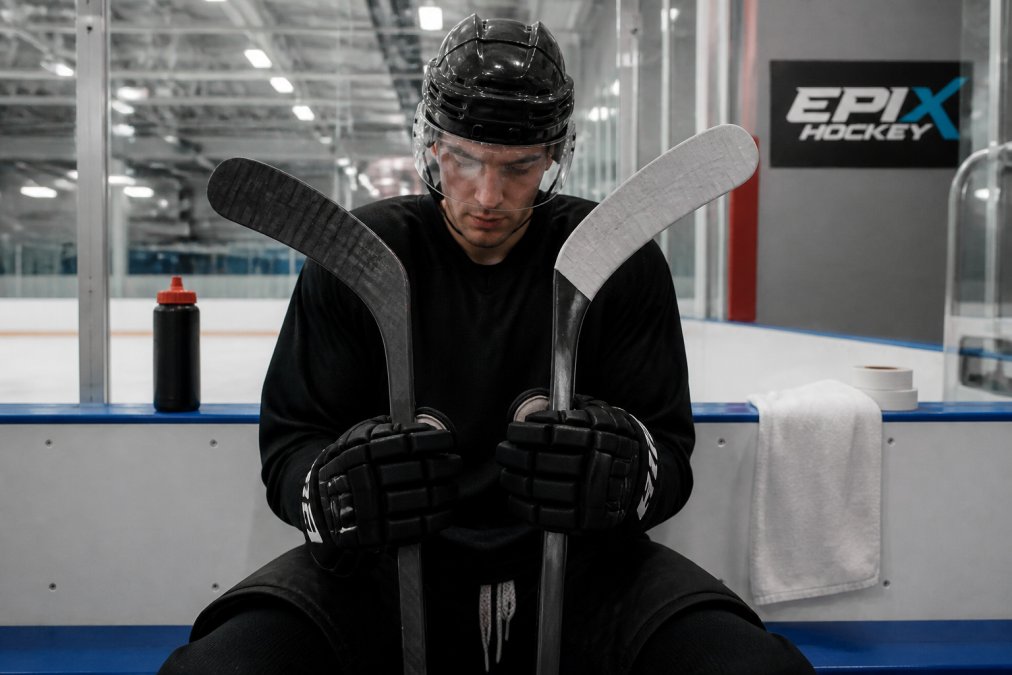
Work through these in order:
- Identify your primary shot. If most of your goals come off quick wristers, prioritize a livelier blade. If you shoot from the point, prioritize stiffness.
- Match the pattern to your role. Playmakers generally prefer an open mid-curve for control. Shooters often prefer a closed toe for a harder, more predictable release.
- Check the lie. The lie angle determines how much of the blade sits flat on the ice. Too upright and you lose puck coverage. Too flat and you expose the toe.
- Consider your level and growth. A younger player still developing their shot does not need an elite-spec core. A durable, balanced hybrid core serves them longer.
A common mistake is buying the stiffest blade available because it sounds more advanced. For most players below elite level, that choice costs accuracy and feel with no real durability gain.
When Hybrid Blade Cores Fail: Troubleshooting Common Problems
Hybrid core failures almost always trace back to one of four root causes: moisture intrusion, bonding separation, heat stress, or impact damage that never got inspected. Most guides stop at listing symptoms. The useful skill is working backward from the symptom to the cause, because the cause determines whether the stick is repairable or done.
The Diagnostic Sequence
Work through these in order. Stop at the first one that matches.
- Tap test. Tap the blade on the ice or a bench. A consistent, sharp report across the whole face is healthy. A dull thud in one spot means the internal bond has separated there.
- Flex test. Grip the blade and shaft and apply gentle opposing pressure. You are listening and feeling for a creak or a soft hinge point, not trying to bend it far.
- Visual inspection at the hosel. The blade-to-shaft joint takes the highest stress of any point on the stick. Look for a hairline crack or a whitish stress line where the layers meet.
- Moisture check. If the stick has been stored in a damp bag or left in standing water, assume moisture intrusion until proven otherwise. A musty smell or a soft, spongy feel near the heel is confirmation.
- Heat history. Ask yourself where the stick has been stored. A trunk in summer or a garage in direct sun can soften the resin matrix without any visible damage.
Failure Modes, Causes, and What They Mean
| Symptom | Likely Root Cause | Repairable? |
|---|---|---|
| Soft spot near the heel | Bonding separation from repeated flex | No, internal |
| Cracking along the blade face | Impact damage, slashes, blocked shots | No, spreads fast |
| Delamination at the hosel | Stress concentration at the joint | No, structural |
| Sudden loss of pop, no visible damage | Core crush from heat or overload | No, internal |
| Mushy feel after wet storage | Moisture intrusion into the matrix | No, bonding compromised |
| Creaking under flex | Early bonding separation | No, catch it early |
The pattern here is uncomfortable but honest: by the time a hybrid core shows symptoms, the damage is almost always internal and not repairable. That is why the diagnostic sequence matters, it tells you when to stop using a stick before it fails mid-shot, not how to fix it.
The Two Failures You Can Actually Prevent
Most failure modes are terminal, but two are preventable with storage habits alone:
- Heat stress. Resin matrices soften at temperatures a parked car reaches easily in summer. Once the matrix softens, the core can crush under normal shooting loads. Store sticks indoors.
- Moisture intrusion. Standing water and damp equipment bags attack the bonding layer over weeks, not days. Dry your stick after every session and never leave it in a wet bag overnight.
Hybrid Blade Cores and the Environment: What Manufacturing Leaves Behind
Manufacturing synthetic hybrid cores carries a real environmental cost, and it is worth understanding before you buy. Composite production uses resin systems, energy-intensive curing, and fibers that are difficult to recycle at end of life.
The honest picture:
- Energy use. Curing composite layups requires sustained heat, which drives up the embodied energy of every stick.
- Material waste. Offcuts and failed layups are common in composite manufacturing, and recycling cured carbon fiber remains technically difficult.
- Longevity as the lever. The single biggest environmental factor is how long a stick lasts. A blade core that resists failure for multiple seasons spreads its manufacturing footprint over far more ice time.
That last point is where hybrid core design has a genuine environmental argument, separate from performance. Durability is a sustainability feature, not just a playing one.
Conclusion
Blade cores are the least visible and most consequential part of a stick, and the wrong core quietly costs you release speed and accuracy all season. Epix Hockey builds around aerospace-grade carbon fiber and our Elite Fusion Matrix, with proprietary kick profiles including Neo-Mid, LightSpeed Low, and Synth Hybrid, plus customizable specs so the blade matches your shot instead of the other way around. Every stick is validated through third-party testing and real-world play. If you want a blade that holds its feel and its structure, get started with Epix Hockey and build a stick around your game.
Frequently Asked Questions
What is a synthetic hybrid blade core in a hockey stick?
A synthetic hybrid blade core combines two or more materials inside the blade, typically a lightweight foam or polymer base reinforced with carbon fiber, boron, or titanium-infused layers. The goal is to get the puck feel of a softer core with the stiffness and durability of a harder one. Epix Hockey builds its Synth Hybrid profile with Bladerunner CRBN and Boron24x fibers, which adapt to different shooting motions instead of forcing one release style.
How does blade core material affect puck feel and control?
Softer cores absorb more vibration on impact, which gives you a quieter, more connected feel when receiving passes and stickhandling in traffic. Harder cores transmit more energy back into the puck, which helps shot power but can feel harsh on bad receptions. Hybrid cores sit between the two: the outer layers stay stiff for shooting, while the inner material dampens vibration so the puck settles on your blade faster during quick touches.
Are synthetic hybrid blades more durable than traditional wooden or foam blades?
Generally yes, with one caveat. Wood cores can absorb water and delaminate over a season, and basic foam cores crack under repeated impact. Hybrid cores bond synthetic layers to the foam, which spreads stress across the blade instead of concentrating it at one point. That said, durability still depends on how you use the stick. Slap shots off the heel, cold storage, and leaving gear in a hot car all shorten blade life regardless of construction.
How do hybrid cores contribute to shot accuracy and release speed?
The blade has to stay square through the release or the puck drifts offline. A hybrid core resists twisting better than a soft foam blade, so the puck leaves the same spot on the blade face every time. Epix Hockey's third-party testing shows an average 3.2% increase in release speed and 4.3% improvement in accuracy across its hybrid profiles. Those numbers come from comparing the same player, same flex, and same curve across core types, not from a single test shot.
How does the Elite Fusion Matrix technology compare to standard hybrid cores?
Standard hybrid cores usually pair one foam type with one carbon layer. The Elite Fusion Matrix combines aerospace-grade carbon fiber with multiple fiber orientations, so the blade can be stiff in one direction and forgiving in another. In practice, that means the blade holds its shape on hard shots but still flexes slightly on receptions. It is the same principle behind Boron24x fibers in the Synth and Neo-Mid kick profiles.
Do I need a hybrid blade core if I am a recreational player?
You will notice the difference most on bad ice and in cold rinks, where cheaper blades go dead and vibrate. Recreational players who play once or twice a week may not need the top spec, but a hybrid core still helps with pass reception and stickhandling in traffic. If you are buying one stick for the season, the durability alone often justifies the step up from a basic foam blade.
What flex and kick point should I order if I cannot try the stick first?
Start with flex at roughly half your body weight in pounds, then adjust down if you are a lighter shooter or up if you lean into slap shots. For kick point, a mid kick like the Neo-Mid profile suits players who shoot from everywhere and want a balanced release. A low kick like LightSpeed Low favors quick wristers in tight. A Synth profile adapts to both, which is the safer pick when you are ordering online without a demo.