

Impact of Stick Weight on Performance: Full Guide
Table of Contents
- How Stick Weight Influences Shot Velocity and Release Speed
- Stick Weight vs Puck Handling, Hand Speed, and Stick Control
- The Benefits of Aerospace Grade Carbon Fiber in Stick Construction
- Hockey Stick Flex vs Weight: How They Work Together
- Weight Distribution and Balance Point: The Spec That Decides Feel
- How to Choose the Right Hockey Stick Weight for Your Position and Level
- Frequently Asked Questions
Last Updated: September 17, 2026
How Stick Weight Influences Shot Velocity and Release Speed
The impact of stick weight on performance starts with a simple trade-off: lighter sticks accelerate faster in your hands, while heavier sticks carry more momentum into the puck. At Epix Hockey, we build sticks in the 285 to 425 gram range because that band covers the vast majority of players without forcing a compromise on either side.
Walk into any pro shop and you'll hear the same claim: lighter equals better. That's only half true, and the half that's missing is the one that decides whether your shot actually gets harder.
Here's the physics in plain terms. A stick is a lever, and your hands are the pivot. A lighter shaft lets you rotate that lever faster, which raises the speed of the blade at contact. A heavier shaft resists that rotation but stores more energy when it flexes. Which one wins depends on how much of your shot comes from hand speed versus body weight and flex load.
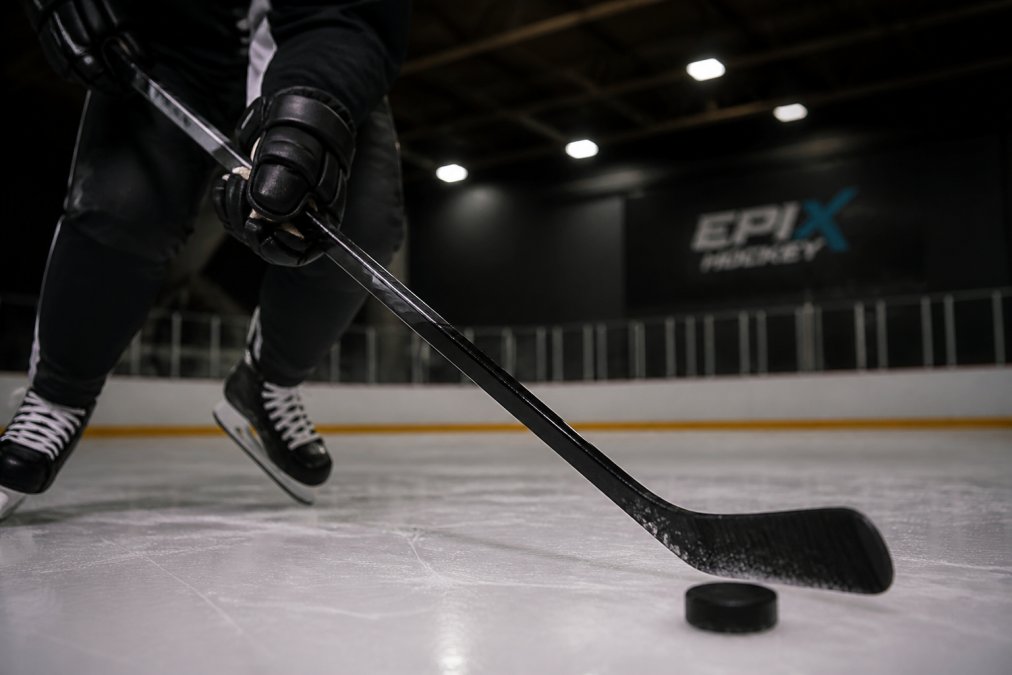
The Physics of Stick Acceleration and Kinetic Energy
Kinetic energy scales with the square of velocity, so blade speed matters far more than mass. Take a 395 gram stick and a 350 gram stick swung at the same rate and the heavier one delivers more energy. But that's not what happens in practice. The lighter stick reaches a higher blade speed because your arms and wrists can accelerate it faster, and that squared velocity term usually closes the gap.
What most guides miss is that this flips depending on your release type. On a quick snap shot where the puck leaves in a fraction of a second, hand speed dominates and lighter wins. On a full slap shot with a long wind-up and heavy flex load, the extra mass contributes more and the difference narrows.
Stick Weight vs Puck Handling, Hand Speed, and Stick Control
Lighter sticks win on puck handling and hand speed for one reason: less mass at the end of your arms means faster direction changes. If you play a possession game with quick stick checks and tight turns, a 315 gram intermediate or a 350 gram senior stick with a low balance point will feel quicker than a heavier build of the same length.
The trade-off shows up in stability. A heavier shaft resists deflection when you take a hit or dig for a puck along the boards. Players who lean on their stick for balance or battle in front of the net often prefer that resistance.
Where it gets interesting is stick length. Adding length moves mass further from your hands, which increases swing weight even if total grams stay the same. Cutting a stick down does the opposite. This is why two sticks with identical listed weights can feel completely different on the ice.
Stick Weight Band |
Best For |
Trade-Off |
|---|---|---|
285-315 g |
Quick release, puck handling, youth and intermediate players |
Less momentum on full wind-up shots |
320-350 g |
Balanced shooting and control, most senior players |
Slightly slower hand speed |
350 g+ |
Heavy flex loads, physical play, stability |
Slower direction changes |
The Benefits of Aerospace Grade Carbon Fiber in Stick Construction
Aerospace grade carbon fiber is the reason a modern stick can sit in the 300 gram range without turning into a noodle. The material itself doesn't make you shoot harder, it changes the weight-to-stiffness ratio, and that ratio is what determines whether a light stick can still store and return energy on a full shot.
Here's the mechanism. A stick's shaft is a spring. When you load it, the fibers stretch on one side and compress on the other, and the resin system holds that geometry until you release. Lower-grade composites need more material to survive that cycle, which adds grams. Aerospace-grade layups use higher tensile-strength fibers and tighter resin control, so engineers can remove material while keeping the same stiffness and fatigue life. The result is a lighter shaft that still returns energy predictably instead of going soft after a few months.
That predictability matters more than the gram count. A stick that loses stiffness over a season changes your release point without you noticing, which is why players sometimes blame their shot mechanics when the real issue is a fatigued shaft. Fiber orientation and resin systems are the variables that separate a stick that holds its flex profile from one that doesn't, the University of Cambridge's engineering resources Composite materials overview from the University of Cambridge's engineering resources explain how those two factors drive stiffness-to-weight ratios in composite structures.
Epix Hockey pairs aerospace-grade carbon fiber with our Elite Fusion Matrix material and Bladerunner CRBN and Boron24x Fibres. The practical effect is a shaft that holds its shape under repeated flex cycles, so the load and release feel stays consistent from the first shift to the last. That consistency is what lets you actually feel the difference between a 315 gram and a 350 gram build, if the shaft is changing under you, weight comparisons become noise.
Durability is part of the performance equation, not separate from it. A lighter stick that chips or delaminates after a few months costs more than a heavier one that lasts a season, and a stick that's cracked at the blade or hosel won't transfer energy cleanly no matter how light it is. When you're comparing weights, factor in how the construction holds up to board battles, face-off torque, and cold-weather brittleness. The lightest stick in the shop is only an advantage if it's still intact in March.
Hockey Stick Flex vs Weight: How They Work Together
Flex and weight are separate specs that interact constantly, and treating them as one number is a common mistake. Flex measures how much force it takes to bend the shaft a set amount. Weight measures how much mass you're swinging. A stiff, light stick and a flexible, light stick behave nothing alike, even though they weigh the same on a scale.
The interaction shows up in the load-and-release sequence. To get power out of a stick, you have to bend it, and the amount you can bend it depends on your strength relative to the flex rating. A player who can't load a 100-flex shaft never gets the return force, so a lighter stick in that flex just feels dead. A player who over-loads an 85-flex shaft loses accuracy because the blade kicks before they're ready. Weight changes how fast you can move the stick; flex changes how much energy the stick gives back. You need both matched to your shot.
The general rule is that lighter sticks suit players who generate their own power, because they don't need the shaft to do as much work.
Weight Distribution and Balance Point: The Spec That Decides Feel
Balance point matters more than total weight, and almost nobody talks about it. Two 350 gram sticks can feel like completely different tools depending on where the mass sits along the shaft.
How to Choose the Right Hockey Stick Weight for Your Position and Level
Match the weight band to your position, your release type, and your age or strength level, then adjust from there. There's no single best number, but there is a best starting point for each player profile.
Here's a starting framework:
- Youth and intermediate players: 285-315 g, flex matched to body weight, prioritize hand speed development
- Senior forwards, quick release game: 315-350 g with a low balance point
- Senior defenders and physical players: 350 g, accept slightly slower hands for stability
- Players returning from wrist or hand injury: consider a more flexible profile to reduce shock transfer
Frequently Asked Questions
Does a lighter hockey stick actually increase shot velocity?
A lighter stick can increase hand speed and acceleration, which helps with quick release and snap shots. However, shot velocity depends on the load and release of the shaft flex, not just weight. A stick that is too light may transfer less kinetic energy into the puck. The best approach is finding a weight that lets you load the shaft fully while staying quick through shooting mechanics.
How does stick weight affect puck handling and stickhandling speed?
Lighter sticks allow faster hand speed and quicker adjustments, which improves agility in tight spaces. Heavier sticks offer more stability and blade feel, helping with stick checks and control under pressure. Most competitive players benefit from a balanced weight that supports both quick hands and a solid feel on the puck.
Is there an ideal weight range for competitive hockey sticks?
Junior and intermediate sticks scale down accordingly, with junior models often around 285 to 315 grams.
How do I choose the right stick weight if I can't try it first?
Start with your position and playing style. Forwards who shoot often should lean toward lighter sticks for faster release. Defenders may prefer slightly heavier sticks for stability and stick checks. Also match flex to your body weight and strength, since flex affects how well you can load the shaft. Customizable options let you dial in weight, flex, and kick point together.