

How to Improve Your Passing: A 25-Year Player's Guide
Table of Contents
- Why Passing Fundamentals Matter More Than You Think
- The Technical Foundation: Body Mechanics and Ball Control
- Types of Passes and When to Use Them
- Hockey Passing Drills for Accuracy
- How to Receive a Hockey Pass With Control
- Decision-Making Under Pressure and Tactical Awareness
- Video Analysis and Self-Correction
- The Equipment Factor: How Your Stick Affects Passing Performance
- Frequently Asked Questions
Last Updated: September 2, 2026
Why Passing Fundamentals Matter More Than You Think
After 25 years on the ice, I've watched countless players obsess over their shot while neglecting the skill that truly separates dominators from those who plateau: passing ability. A player who delivers crisp passes in transition creates scoring chances. A player who can't forces teammates into difficult positions and turns possessions into turnovers. The best players I've played with weren't always the ones with the hardest shot, they were the ones who could thread a pass through traffic with precision and timing.
Your passing ability determines your value to any team. It's the foundation of every successful play, every scoring chance, and every comeback. The technical foundation isn't complicated, but it's also not something you can fake.
The Technical Foundation: Body Mechanics and Ball Control
The biggest mistake I see players make is treating passing like an afterthought. Your body position, plant foot, and follow-through aren't minor details, they're the difference between a pass that lands on a teammate's tape and one that sails into the boards.
Plant Foot Positioning and Follow-Through
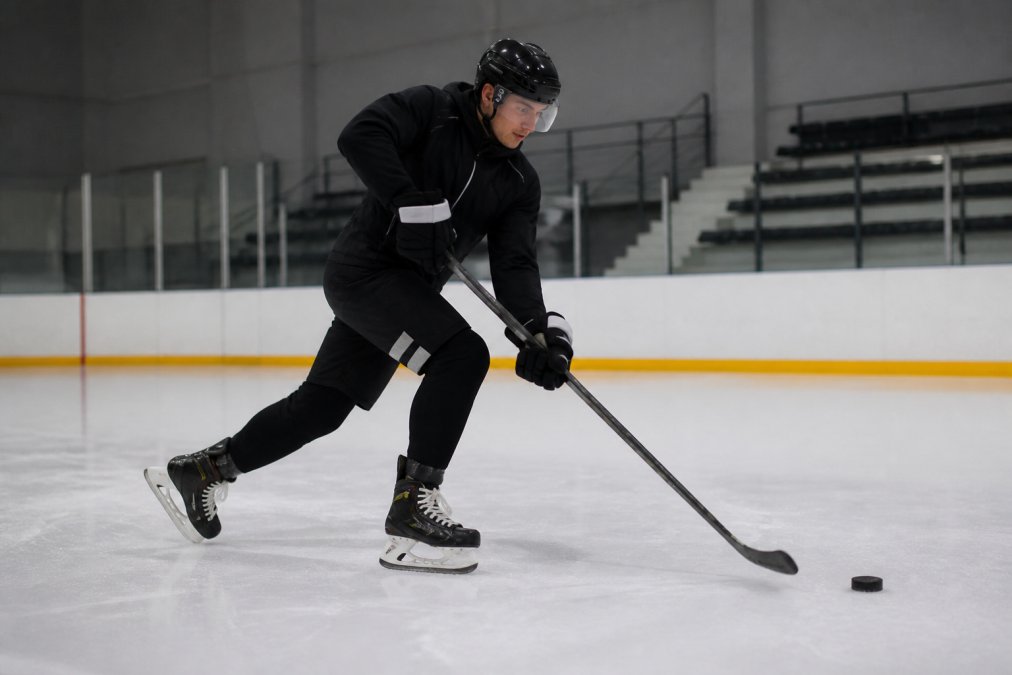
Your plant foot is your anchor. When passing, your non-stick-side foot should be planted firmly in the direction you want the puck to travel. This gives you stability and control. The follow-through is where your pass gets its weight and direction. After contact, your stick should continue moving toward your target in a smooth, controlled extension. Your body should rotate naturally, with your shoulders facing your target at the end of the motion.
Think of it like a pendulum: your plant foot is the pivot point, your stick and body swing through smoothly, and the puck travels along that line of motion. When your mechanics are clean, passing becomes predictable.
Passing With Different Parts of the Foot
Most players stick to the instep, the inside curve of your stick blade, which gives the best control for short passes. The laces, the top edge of your blade, provide a different angle for quick directional passes. The outside of the foot offers reach and can surprise a defender. A player who can only pass with the instep is predictable. A player with multiple passing surfaces is dangerous.
Types of Passes and When to Use Them
Understanding which pass to throw in which situation is where decision-making meets technique. A good pass gets your teammate the puck in a position where they can succeed.
Short Passing and Puck Distribution
Short passes, typically within a few meters, are your foundation. These keep possession and move the puck laterally or backward. The puck should travel on the ice, hit your teammate's stick, and stick there. No bouncing. No sliding. This requires touch, not raw power. Most of your passing volume will be short passes. A team that moves the puck quickly with short, accurate passes controls possession.
Long-Range Passing and Through Balls
Long-range passing breaks the opponent's forecheck. A crisp pass over a significant distance can turn defense into offense in one motion. A through ball threads the puck between defenders or into open ice ahead of a moving teammate. The timing has to be perfect, too early and it gets intercepted, too late and your teammate is out of position. Through balls create scoring chances because they put your teammate in space with speed. Long-range passing requires more weight on the puck than short passing, but not so much that it's hard to control.
Saucer Pass Technique and Execution
A saucer pass flips the puck over an opponent's stick using a scooping motion with the blade. The puck travels in an arc and lands flat on the ice. The sweet spot is a shallow arc, just enough lift to clear the obstacle, but not so much that it's difficult to control when it lands. Use saucer passes in the offensive zone when getting the puck to a teammate in front of the net with a defender in the way, or in transition when breaking the forecheck.
Hockey Passing Drills for Accuracy
Drills are where passing becomes automatic. Game situations are chaotic, and if your passing mechanics aren't ingrained, you'll revert to bad habits under pressure.
One-Touch Passing and Decision-Making
One-touch passing, receiving and passing immediately without controlling the puck first, is the highest level of passing skill. Set up three players in a triangle, a few meters apart. Player A passes to Player B, who one-touches to Player C, who one-touches back to Player A. Keep the puck moving constantly. Start slow and increase tempo. As pace increases, you'll find the edge of your ability and push past it. After consistent practice, one-touch passing becomes natural.
Drills for Different Skill Levels
Beginner players should focus on stationary passing to targets for accuracy and consistency. Intermediate players should add movement, pass while skating, receive while moving, add non-checking defenders for game-like conditions. Advanced players should run game-situation drills: 3-on-3 in small areas, transition drills with forechecking pressure, breakout drills under game conditions. Build from the ground up, you can't run advanced drills if fundamentals aren't solid.
How to Receive a Hockey Pass With Control
Receiving a pass is half the equation. A great pass is only great if the receiver can control it.
First Touch and Scanning the Ice
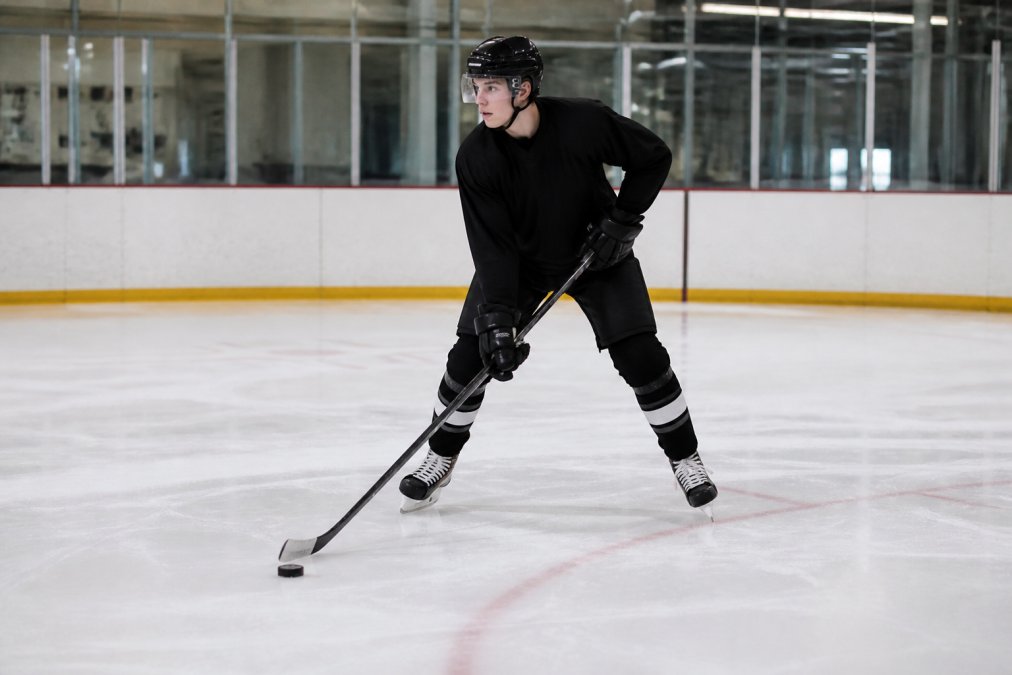
Your first touch is critical. When the puck arrives on your stick, cushion it by relaxing your hands slightly so it doesn't bounce away. At the same time, scan the ice. Before you even receive the pass, know what you're going to do with it. Where is open ice? Where are the defenders? What's your next move? The best players receive the puck already knowing their next three options. A poor first touch forces recovery. A good first touch puts you in position to make an immediate play.
Reading Tempo and Weight of Pass
Different passes require different receiving techniques. A soft pass needs a soft touch. A hard pass needs a firmer stick. You're reading the weight of the pass as it arrives and adjusting accordingly. The best passes are weighted so they arrive at the right speed for you to receive and immediately play them.
Decision-Making Under Pressure and Tactical Awareness
You can have perfect mechanics, but poor decision-making makes you a liability. The best passers I've played with made the right play at the right time. When you receive the puck with a defender closing in, you have maybe two seconds to decide: do you pass, to whom, and what's the risk versus reward?
Tactical awareness means understanding your team's system and your role within it. The best way to improve decision-making is to play. Scrimmages and games teach you when to use which technique under real pressure.
Video Analysis and Self-Correction
Modern hockey has an advantage: video. Record your games, watch them back, and see exactly where you're making mistakes. Watch your turnovers. What led to each one? Was it a bad pass, poor decision-making, or a pass that was too soft or too hard? Once you identify the pattern, work on fixing it. Be honest with yourself, own your mistakes and work on them.
The Equipment Factor: How Your Stick Affects Passing Performance
Your stick matters more than most players realize. A stick with the right kick point for your style makes passing easier. The kick point is where the stick flexes when you load it. Some players prefer a mid-kick point for balance of control and power. Others prefer a low-kick point for faster release. The Epix Hockey team has engineered sticks with proprietary kick point technologies like the Neo-Mid and LightSpeed Low profiles specifically to give players options based on their passing style.
Material also matters. Aerospace-grade carbon fiber construction gives you consistent flex and feel. Cheaper sticks with lower-quality materials can feel mushy or unpredictable. Curve selection affects passing too. A deeper curve gives more control on short passes but can make longer passes harder. A shallower curve is more versatile. The Epix Hockey custom options let you dial in exactly what you need.
I've seen players switch to the right stick and immediately improve their passing. Not because they suddenly understood mechanics better, but because the tool was finally responding as expected. That consistency removes a variable from the equation.
The Darkmatter series from Epix Hockey, available in Senior, Intermediate, and Junior sizes, combines titanium-infused carbon construction with the LightSpeed Low kick profile. For players serious about improving passing accuracy and release speed, this equipment makes a measurable difference. The Custom DarkMatter option lets you build a stick that matches your passing style perfectly.

Your passing ability determines your value on the ice. Master the fundamentals, your plant foot, follow-through, and touch on different surfaces. Understand which pass to throw in which situation. Practice under pressure until your decisions become instinctive. Invest in equipment that responds the way you expect it to. With Epix Hockey's customizable stick options and precision-engineered kick point technologies, you get gear that supports your development as a passer. Start with the Darkmatter series or build your ideal stick with Custom DarkMatter. The difference in your game will be immediate.
Frequently Asked Questions
How do I improve my passing accuracy under pressure?
Focus on first touch and scanning. Before you receive the puck, know where your passing lanes are and who's open. Under pressure, simplify: use shorter passes to safer targets rather than forcing long-range attempts. Practice one-touch passing drills where you receive and distribute in a single motion. The key is repetition in game-speed scenarios so your decision-making becomes automatic.
When should I use a saucer pass versus a direct pass?
Use direct passes (along the ice) when there's a clear lane and you want maximum control and speed. Use a saucer pass when defenders are blocking the ice-level passing lane or when your teammate is in a tight space where a bouncing puck would be difficult to control. Saucer passes take longer to execute, so timing and vision matter more. On the forecheck or in transition, direct passes are faster; in the offensive zone with traffic, saucer passes create better scoring chances.
What are common mistakes players make when passing the puck?
Poor scanning before receiving leads to turnover passes. Not adjusting the weight of your pass for your teammate's speed or positioning causes them to break stride. Telegraphing passes by looking at your target before releasing—defenders read this instantly. Inconsistent follow-through reduces accuracy. Many players also pass too hard in tight spaces or too soft on long-range attempts. Record yourself or ask a coach to watch your tape; you'll spot patterns quickly.
How can I improve my passing vision and anticipation?
Spend time studying how the ice opens up during play. Watch where passing lanes develop before the puck arrives. Practice scanning constantly, even when you don't have the puck. Play small-area games and possession drills where you're forced to move the puck quickly and read defensive pressure. Watch video of high-level players and notice their head movement and positioning before they receive passes. Vision improves through repetition and conscious awareness of space, not just technical drills.